Subrogation Process Explained: What US Policyholders Need to Know
The Subrogation Process Explained: What U.S. Policyholders Need to Know After a Claim Payout
As a policyholder in the United States, you’ve likely heard the term ‘subrogation’ in passing, perhaps during an insurance claim or while reviewing your policy documents. However, for many, the subrogation process explained remains a nebulous concept. It’s a critical component of the insurance ecosystem, designed to ensure fairness and prevent unjust enrichment, yet it often causes confusion and anxiety for those involved. Understanding subrogation is not just about legal jargon; it’s about comprehending your rights, responsibilities, and the broader implications for your financial well-being after an insurance claim payout.
This comprehensive guide aims to demystify the subrogation process explained, providing U.S. policyholders with a clear, in-depth understanding of what happens when your insurer seeks recovery from a third party. We’ll delve into the fundamental principles, the step-by-step procedure, your role as a policyholder, and common pitfalls to avoid. By the end of this article, you will be equipped with the knowledge to navigate the subrogation landscape with confidence, ensuring you are prepared for any scenario that may arise.
What Exactly is Subrogation? A Core Principle Explained
At its heart, subrogation is the legal right of an insurer to pursue a third party that caused an insurance loss to the insured. It allows the insurance company to recover the amount of the claim paid to its policyholder from the at-fault party. Think of it this way: if someone else damages your property, and your insurance company pays for the repairs, subrogation enables your insurer to step into your shoes and sue the responsible party for the damages. This prevents you, the policyholder, from recovering twice for the same loss (once from your insurer and once from the at-fault party) and ensures that the financial burden ultimately falls on the party responsible for the damage.
The concept of subrogation has deep roots in common law and is now widely incorporated into insurance contracts across the United States. It serves several crucial purposes:
- Prevents Double Recovery: Without subrogation, a policyholder could potentially collect damages from their insurer and then again from the at-fault party, leading to unjust enrichment.
- Holds At-Fault Parties Accountable: It ensures that the party legally responsible for the loss bears the financial consequences, promoting accountability and discouraging negligence.
- Keeps Premiums Lower: By recovering funds from at-fault parties, insurance companies can offset their losses, which can contribute to more stable or even lower premiums for all policyholders over time.
- Maintains Equity: It provides a mechanism for the insurer, who has paid for a loss that was not their fault, to be reimbursed.
For the subrogation process explained, it’s essential to understand that it typically begins *after* your insurer has paid your claim. Until your claim is settled and you’ve received your payout, subrogation isn’t usually an active concern for your insurer. Once they’ve fulfilled their obligation to you, their focus shifts to recovering those funds from the party responsible.
The Legal Basis of Subrogation in U.S. Insurance
Subrogation isn’t just an arbitrary practice; it’s a legally recognized right. In the U.S., it can arise from several sources:
- Contractual Subrogation: This is the most common form, explicitly stated in your insurance policy. Most policies contain a clause granting the insurer the right to subrogate against a third party.
- Equitable Subrogation: This arises by operation of law, even if not explicitly stated in the contract, to prevent injustice. It’s based on fairness and the principle that one party (the insurer) shouldn’t bear a loss caused by another (the at-fault party).
- Statutory Subrogation: In some cases, specific state laws may grant an insurer subrogation rights, particularly in areas like workers’ compensation or no-fault auto insurance.
Understanding which type of subrogation applies can sometimes be complex, but for most policyholders, the contractual subrogation clause in their policy is the primary driver. It’s always advisable to review your policy documents carefully or consult with an insurance professional if you have questions about specific language related to subrogation.
When Does Subrogation Come into Play? Common Scenarios
The subrogation process explained is relevant in various insurance contexts. Here are some of the most common scenarios where it’s applied:
- Auto Insurance: If another driver causes an accident that damages your car, your collision coverage pays for the repairs. Your insurer then subrogates against the at-fault driver’s insurance company to recover the money.
- Property Insurance (Homeowners/Renters): If a neighbor’s tree falls on your house, or a contractor’s negligence causes damage, your homeowners’ policy covers the repairs. Your insurer might then subrogate against the neighbor or contractor.
- Health Insurance: If you’re injured in an accident caused by someone else (e.g., a car accident, slip and fall), your health insurer might pay your medical bills. They may then seek to recover those costs from the at-fault party’s liability insurance.
- Workers’ Compensation: If an employee is injured on the job due to a third party’s negligence (e.g., a defective machine manufacturer), the workers’ comp insurer pays benefits. They may then subrogate against the manufacturer.
In essence, any time your insurer pays for a loss that was caused by someone else’s negligence or wrongdoing, there’s a potential for subrogation. The key is that a third party must be legally liable for the damage or injury.
The Step-by-Step Subrogation Process Explained for Policyholders
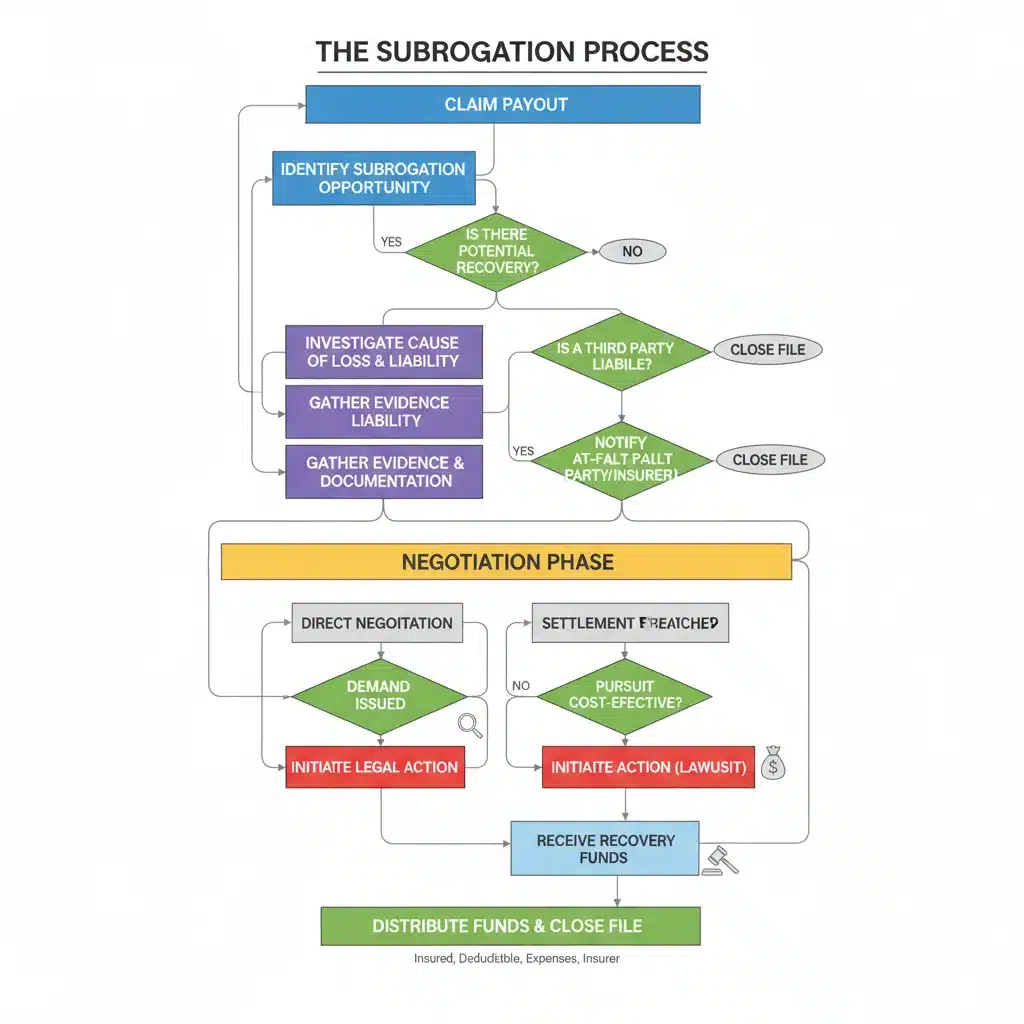
Navigating the aftermath of a claim can be stressful enough without the added complexity of subrogation. Let’s break down the typical steps involved in the subrogation process explained from a policyholder’s perspective:
Step 1: The Incident Occurs and You File a Claim
This is the starting point. An event happens (e.g., car accident, property damage) that triggers your insurance coverage. You notify your insurance company and file a claim according to your policy’s terms.
Step 2: Your Insurer Investigates and Pays Your Claim
Your insurance company investigates the incident to determine coverage and the extent of damages. Once they confirm coverage and assess the loss, they will pay you for your covered damages, minus any deductible. This payment makes you whole under your policy.
Step 3: Identification of the At-Fault Party
During their initial investigation, or sometimes after paying your claim, your insurer will identify a third party who is legally responsible for the loss. This could be another driver, a property owner, a manufacturer, or another entity.
Step 4: The Subrogation Demand
Once your insurer has paid your claim, they will initiate the subrogation process. This typically involves sending a formal subrogation demand letter to the at-fault party or their insurance company. This letter outlines the damages paid, asserts the insurer’s right to recover, and requests reimbursement.
Step 5: Negotiation and Settlement
The at-fault party’s insurer (or the party themselves) will review the demand. Negotiations may ensue regarding liability and the amount of damages. This can be a back-and-forth process, much like a regular claim settlement. The goal is to reach a settlement where the at-fault party or their insurer reimburses your insurer.

Step 6: Litigation (If Necessary)
If negotiations fail, or if the at-fault party disputes liability or the amount of damages, your insurer may decide to file a lawsuit against the at-fault party to recover the funds. This is typically a last resort, as litigation can be costly and time-consuming. However, it demonstrates the insurer’s commitment to recovering their losses.
Step 7: Recovery and Reimbursement of Deductible
If your insurer successfully recovers funds from the at-fault party, they will first reimburse themselves for the amount they paid you. Importantly, if you paid a deductible, your insurer is generally obligated to recover your deductible on your behalf from the at-fault party. Once recovered, they will send your deductible back to you. This is a critical aspect of the subrogation process explained for policyholders, as it directly impacts your out-of-pocket expenses.
Your Role as a Policyholder in the Subrogation Process
While subrogation is primarily a matter between your insurance company and the at-fault party, your cooperation is often essential. Here’s what you, as a policyholder, need to know:
- Cooperate with Your Insurer: Your policy likely contains a cooperation clause, obligating you to assist your insurer in their subrogation efforts. This might involve providing statements, documents, or even testifying if a lawsuit is filed. Failure to cooperate could jeopardize your coverage.
- Do Not Release the At-Fault Party: After receiving your claim payout, it’s crucial not to sign any release or settlement agreement with the at-fault party or their insurer without first consulting your own insurance company. Doing so could waive your insurer’s subrogation rights, potentially leaving you responsible for your deductible or even facing a demand for repayment from your insurer.
- Protect Your Deductible: As mentioned, your insurer typically has a duty to recover your deductible for you. Stay in communication with your insurer about the status of their subrogation efforts, especially if you haven’t received your deductible back in a reasonable timeframe.
- Avoid Double Recovery: Do not attempt to recover damages directly from the at-fault party for losses your insurer has already paid for. This would constitute double recovery and could lead to legal issues.
- Keep Records: Maintain thorough records of all communications, documents, and expenses related to your claim and the subrogation process.
Understanding your obligations and rights during the subrogation process explained ensures a smoother experience and protects your financial interests.
The Importance of Your Deductible in Subrogation
For many policyholders, the most tangible impact of subrogation is the potential recovery of their deductible. When your insurer pays your claim, they typically subtract your deductible from the payout. If they successfully subrogate against the at-fault party, they will recover the full amount of damages, including your deductible. They are then legally obligated to return your deductible to you.
It’s important to note that the timing of your deductible reimbursement can vary. It depends entirely on the success and speed of the subrogation effort. If the at-fault party’s insurer quickly accepts liability and pays, you might get your deductible back relatively fast. However, if there are disputes, or if litigation is required, it could take months or even years. In some cases, if subrogation is unsuccessful (e.g., the at-fault party is uninsured and has no assets, or liability cannot be proven), you may not get your deductible back.
Always ask your insurance adjuster about the status of subrogation and your deductible reimbursement. This proactive approach ensures you’re informed throughout the subrogation process explained.
Waiver of Subrogation: What It Means
While subrogation is a standard practice, there are instances where it can be waived. A ‘waiver of subrogation’ is an agreement between two parties where one party (typically the insured) agrees to waive their right, and consequently their insurer’s right, to seek recovery from the other party for covered losses. This is common in certain business contracts, such as construction contracts or landlord-tenant agreements.
For example, in a construction project, the property owner might require the general contractor to obtain a waiver of subrogation from their insurer. This means if the contractor’s negligence causes damage to the property, the owner’s insurer cannot then sue the contractor to recover the costs they paid to the owner. The purpose is to simplify the claims process and avoid disputes between parties who are working together on a project.
If you encounter a waiver of subrogation clause in a contract, it’s crucial to understand its implications for your insurance coverage and potential liability. Always consult with legal counsel and your insurance provider before agreeing to such a waiver.
Common Misconceptions About the Subrogation Process Explained
Despite its prevalence, the subrogation process explained is often misunderstood. Let’s debunk some common myths:
- Myth 1: Subrogation means I’ll have to pay my insurer back. No, subrogation is about your insurer recovering from the *at-fault party*, not from you. You might not get your deductible back if recovery is unsuccessful, but you won’t owe your insurer additional money after your claim is paid.
- Myth 2: Subrogation is a quick process. While some cases resolve quickly, many subrogation efforts can take months or even years, especially if liability is disputed or litigation is involved.
- Myth 3: I don’t need to do anything once my claim is paid. Your cooperation is often required, particularly if your insurer needs further information or your testimony. Ignoring your insurer’s requests could have negative consequences.
- Myth 4: My premiums will automatically go up if my insurer subrogates. Your premiums are affected by your claim history and the risk you present. While filing a claim can impact your rates, the success or failure of subrogation itself doesn’t directly dictate a premium increase. However, if your insurer cannot recover from an at-fault party (e.g., uninsured motorist), it might be treated differently than if they recover fully.
- Myth 5: I can settle directly with the at-fault party after my insurer pays me. This is a major pitfall. Settling directly with the at-fault party after your insurer has paid you could jeopardize your insurer’s subrogation rights and potentially obligate you to repay your insurer.
Being aware of these misconceptions is key to navigating the subrogation process explained effectively.
The Role of Attorneys in Subrogation
While your insurance company typically handles the subrogation process in-house, there are situations where attorneys become involved. Your insurer might use their own legal team or hire external counsel to pursue subrogation, especially if the claim is large, liability is complex, or litigation is necessary.
As a policyholder, you generally do not need your own attorney for the subrogation process unless:
- You suffered damages that were not covered by your policy (e.g., pain and suffering, lost wages beyond what your policy covered) and you wish to pursue those directly from the at-fault party.
- Your insurer is not pursuing your deductible recovery diligently, and you believe you need legal assistance to get it back.
- You are being asked to sign documents or provide information that you don’t understand or feel uncomfortable with.
In most straightforward subrogation cases, your insurer will handle the legal heavy lifting. However, if you feel your interests are not being adequately represented, or if your situation is unique, consulting with a personal injury or insurance law attorney can provide clarity and protection.
Tips for Policyholders During Subrogation
To ensure a smooth experience when the subrogation process explained affects you, consider these tips:
- Report Incidents Promptly and Accurately: Provide your insurer with all the details of the incident as soon as possible. Accurate information is vital for both your claim and subsequent subrogation efforts.
- Document Everything: Take photos, gather contact information for witnesses, and keep records of all communications with your insurer and any other parties involved.
- Understand Your Policy: Read your insurance policy carefully, paying close attention to clauses related to subrogation, cooperation, and deductible reimbursement.
- Communicate with Your Adjuster: Stay in regular contact with your insurance adjuster for updates on both your claim and the subrogation process. Don’t hesitate to ask questions.
- Do Not Admit Fault: In the aftermath of an incident, especially an accident, avoid admitting fault to anyone other than your own insurance company or legal counsel. Let the investigation determine liability.
- Be Patient: Subrogation can be a lengthy process. Understand that delays are common, and consistent follow-up is often necessary.
Conclusion: Empowering U.S. Policyholders Through Knowledge
The subrogation process explained is a fundamental, albeit often complex, aspect of the U.S. insurance system. It’s designed to ensure fairness, prevent unjust enrichment, and ultimately hold negligent parties accountable. As a policyholder, understanding this process empowers you to protect your rights, cooperate effectively with your insurer, and ensure the recovery of your deductible when applicable.
While your insurance company takes the lead in pursuing subrogation, your informed cooperation is invaluable. By knowing what to expect, avoiding common pitfalls, and maintaining open communication with your insurer, you can navigate the subrogation process with greater confidence and peace of mind. Remember, your insurance policy is there to protect you, and subrogation is a mechanism that helps uphold the integrity and financial stability of that protection for everyone involved.