Understanding Subrogation: How it Works in Your 2026 Insurance Claims

Understanding Subrogation: How it Works in Your 2026 Insurance Claims
Navigating the world of insurance can often feel like deciphering a complex legal document written in an alien language. Among the many terms that can cause confusion, subrogation stands out as a particularly important, yet often misunderstood, concept. For policyholders in 2026, a clear understanding of how insurance claims subrogation works is not just beneficial, but essential. It can impact your premiums, your claim process, and even your relationship with your insurer.
At its core, subrogation is a legal right held by most insurance carriers to pursue a third party that caused an insurance loss to the insured. Essentially, if your insurance company pays you for a loss, and that loss was caused by someone else, your insurer has the right to step into your shoes and seek recovery from the at-fault party. This prevents you from being compensated twice for the same loss (once by your insurer and once by the at-fault party) and helps your insurer recoup its costs, which can, in turn, help keep premiums stable.
This comprehensive guide will delve deep into the intricacies of insurance claims subrogation, explaining its legal foundations, practical applications in various scenarios, and what it means for you as a policyholder in 2026. We will explore the benefits, potential pitfalls, and best practices to ensure you are well-equipped to handle any subrogation-related issues that may arise.
What Exactly is Subrogation in Insurance?
The term ‘subrogation’ originates from Latin, meaning ‘to put in place of another.’ In the context of insurance, it refers to the legal doctrine under which an insurer, having paid a loss for which a third party is responsible, succeeds to any right of action that the insured may have against that third party. Think of it as your insurer stepping into your shoes to recover money from the person or entity that caused the damage or injury.
The Core Principle of Subrogation
The fundamental principle behind subrogation is to prevent unjust enrichment. Without subrogation, an insured party could potentially collect damages from both their insurance company and the at-fault party, resulting in a double recovery for the same loss. Subrogation ensures that the financial responsibility ultimately falls on the party that caused the damage, and it allows the insurer to recover the funds they paid out, thus mitigating their losses.
Why is Subrogation Important for Policyholders?
While subrogation primarily benefits the insurance company, it also has significant implications for policyholders. Firstly, it ensures that your premiums are not unnecessarily inflated by losses that should be borne by negligent third parties. If insurers can recover their costs, they are better positioned to offer competitive rates. Secondly, it often means you don’t have to wait for the at-fault party’s insurer to settle the claim; your own insurer can pay you upfront and then pursue recovery. This can expedite your claim settlement and repair process.
However, it’s also crucial for policyholders to understand their role in the subrogation process. Often, your policy will contain a subrogation clause, obligating you to cooperate with your insurer in their efforts to recover from the at-fault party. Failure to cooperate could potentially jeopardize your claim or future coverage.
The Legal Basis of Subrogation
Subrogation is not merely an insurance company policy; it is a well-established legal principle. It can arise in two primary ways: by contract (contractual subrogation) or by law (equitable or legal subrogation).
Contractual Subrogation
Most insurance policies today contain explicit subrogation clauses. These clauses outline the insurer’s right to pursue recovery from a third party after paying a claim to the insured. By signing the policy, you agree to these terms, effectively assigning your right to sue the at-fault party to your insurer to the extent of the payment made by them. This is the most common form of subrogation you’ll encounter in insurance claims subrogation.
Equitable (Legal) Subrogation
Even in the absence of a specific contractual clause, courts have long recognized the principle of equitable subrogation. This means that the right of subrogation can exist by operation of law, based on principles of fairness and justice, to prevent unjust enrichment. If an insurer pays a claim that a third party was legally obligated to pay, the law allows the insurer to step into the insured’s shoes to recover those funds.
Waiver of Subrogation
In some contractual situations, particularly in construction or commercial agreements, a ‘waiver of subrogation’ clause might be included. This clause prevents an insurer from seeking recovery from a specific party, even if that party caused the loss. For example, a contractor might require a property owner to waive subrogation against them to protect themselves from liability if they cause damage covered by the owner’s insurance. Understanding such waivers is critical, as they directly impact the insurer’s ability to engage in insurance claims subrogation.
How the Subrogation Process Works in 2026 Insurance Claims
The subrogation process typically follows a series of steps, starting from the incident that leads to a claim and culminating in the insurer’s recovery efforts. While the specifics can vary depending on the type of insurance and jurisdiction, the general flow remains consistent.
Step 1: The Incident and Claim Filing
Everything begins with an incident that causes damage or injury, such as a car accident, property damage, or a medical event. The policyholder then files a claim with their insurance company.
Step 2: Claim Investigation and Payment
Your insurer investigates the claim, determines coverage, and assesses the damages. If the claim is valid, they pay you for your covered losses, often before they have recovered anything from the at-fault party. This is a significant benefit of having insurance – you get compensated quickly, allowing you to repair damages or receive necessary medical care without waiting for external legal proceedings.
Step 3: Identifying the At-Fault Party
During the investigation, if it’s determined that another party is legally responsible for the damages, the insurer identifies this party. This could be another driver, a negligent contractor, a manufacturer of a faulty product, or even a pet owner.
Step 4: Subrogation Demand
Once your insurer has paid your claim and identified the responsible party, their subrogation department (or a third-party subrogation specialist) will initiate contact with the at-fault party or their insurance company. They will present a subrogation demand, seeking reimbursement for the funds they paid out to you.
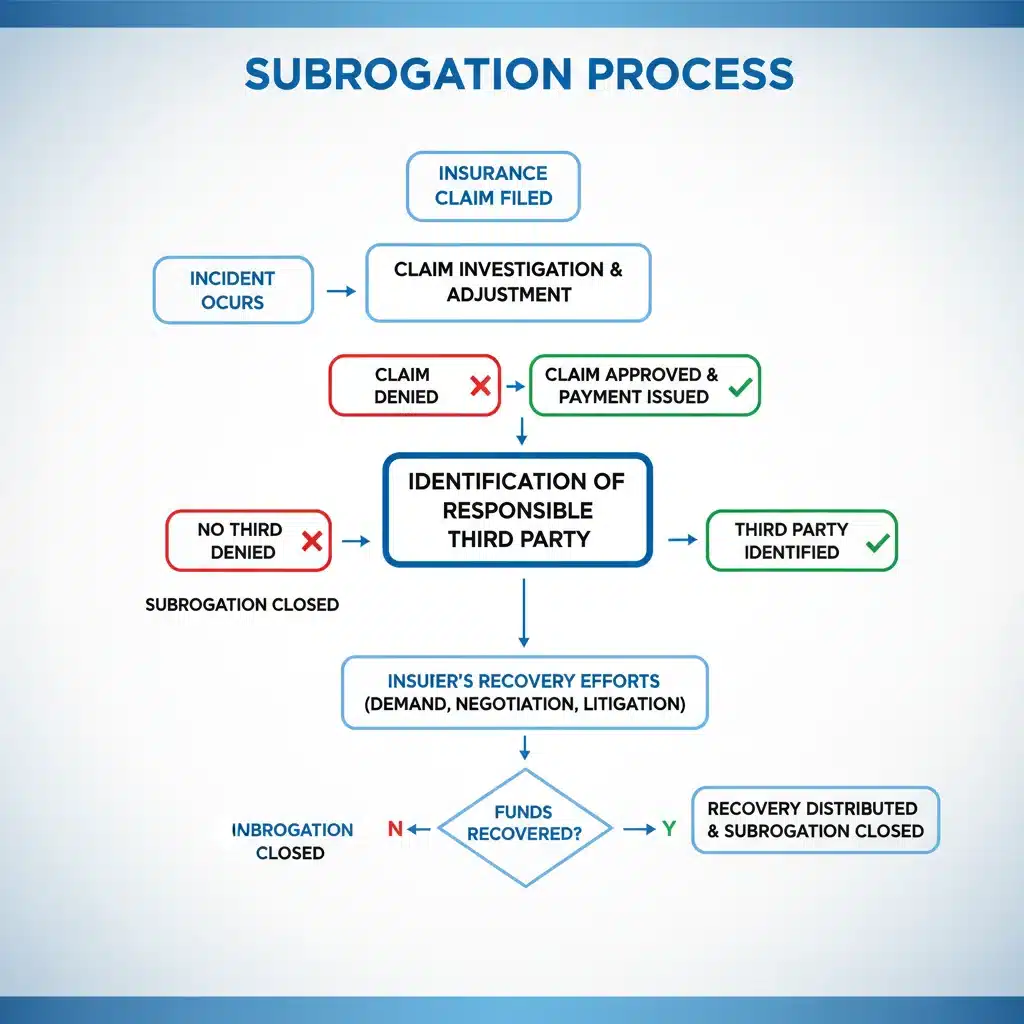
Step 5: Negotiation and Settlement or Litigation
The at-fault party’s insurer (or the party themselves) will then review the demand. This often leads to negotiations. If a settlement is reached, the funds are paid to your insurer. If an agreement cannot be reached, the insurer may choose to file a lawsuit against the at-fault party to recover their losses. This is where the legal aspect of insurance claims subrogation becomes most apparent.
Step 6: Recovery and Potential Reimbursement to Policyholder
If the insurer successfully recovers funds, they will first recoup the amount they paid out to you. If there were any deductibles you paid, or if your damages exceeded your policy limits and you incurred out-of-pocket expenses, the insurer may also seek to recover these on your behalf. In many jurisdictions, the policyholder’s deductible must be recovered first and returned to them before the insurer recoups its own costs. This is an important detail for policyholders to be aware of.
Common Scenarios for Subrogation in 2026
Subrogation is applicable across various types of insurance policies. Here are some common scenarios where insurance claims subrogation frequently occurs:
Auto Insurance Subrogation
This is perhaps the most common example. If another driver causes an accident that damages your car, your collision coverage insurer pays for the repairs. Your insurer then subrogates against the at-fault driver’s liability insurance to recover the costs. If you paid a deductible, your insurer will also typically try to recover that for you.
Property Insurance Subrogation (Homeowners/Renters)
Imagine a neighbor’s tree falls on your house during a storm, or a contractor working on your property accidentally causes a fire. Your homeowners’ insurance would cover the damages, and then your insurer would subrogate against the negligent neighbor or contractor (or their insurance) to recover the payout.
Workers’ Compensation Subrogation
If an employee is injured on the job due to a third party’s negligence (e.g., a faulty piece of equipment from a manufacturer, or a car accident while driving for work caused by another driver), the workers’ compensation insurer pays for the employee’s medical expenses and lost wages. They then have the right to subrogate against the negligent third party to recover those costs.
Health Insurance Subrogation
If you are injured in an accident caused by someone else, your health insurance might pay for your medical treatment. However, they may have a right to subrogate against the at-fault party’s liability insurance (e.g., auto liability or general liability) to recover the costs of your medical care. This is particularly relevant in personal injury cases.
Policyholder’s Role and Responsibilities in Subrogation
While subrogation is primarily handled by the insurance company, policyholders are not entirely passive. Your actions (or inactions) can significantly impact the subrogation process.
Cooperation is Key
Most insurance policies include a clause requiring the insured to cooperate with the insurer’s subrogation efforts. This might involve providing documentation, giving statements, or testifying in court if a lawsuit is necessary. Failing to cooperate could be a breach of your policy terms and might affect your coverage or future claims.
Do Not Release the At-Fault Party
It’s crucial that you do not release the at-fault party from liability or sign any documents that waive your right to pursue them for damages without first consulting your insurer. If you do, you could inadvertently destroy your insurer’s subrogation rights, and they might then seek to recover the claim payment from you.
Protecting Your Deductible
As mentioned, if you paid a deductible, your insurer will typically attempt to recover it from the at-fault party as part of their subrogation efforts. Keep track of all your out-of-pocket expenses related to the incident, as these might also be recoverable through subrogation. In many states, your insurer is legally obligated to seek your deductible first.
Understanding Your Policy
Always review your insurance policy carefully, especially the subrogation clause. Understanding what your policy says about insurance claims subrogation will empower you and help you navigate the process more effectively.
Benefits and Challenges of Subrogation
Subrogation, while a standard part of the insurance landscape, comes with both distinct advantages and potential challenges.
Benefits for the Insurance System and Policyholders
- Reduced Premiums: By recovering losses from responsible parties, insurers can keep their overall costs down, which can translate to more stable or lower premiums for policyholders.
- Fairness and Accountability: Subrogation ensures that the financial burden of a loss ultimately falls on the party responsible for causing it, promoting accountability.
- Faster Claim Settlements: Policyholders often receive their claim payments from their own insurer much faster than if they had to wait for the at-fault party’s insurer to settle. Your insurer handles the lengthy recovery process.
- Deductible Recovery: For many policyholders, successful subrogation means getting their deductible back, which is a direct financial benefit.
Challenges and Considerations
- Time-Consuming Process: Subrogation can be a lengthy process, especially if it involves complex negotiations or litigation.
- Potential for Disputes: The at-fault party or their insurer may dispute liability, leading to prolonged legal battles.
- Impact on Policyholder: While typically minimal, policyholders may be required to provide information or testimony, which can be an inconvenience.
- Partial Recovery: There’s no guarantee of full recovery. If the at-fault party is uninsured or underinsured, or if liability is shared, the insurer might only recover a portion of their payout, and consequently, you might only recover a portion of your deductible.
- Understanding Rights: Policyholders need to be aware of their rights and obligations to avoid inadvertently harming the subrogation process.

What to Expect from Your Insurer During Subrogation
When your insurer initiates insurance claims subrogation, you can expect certain communications and requests. Transparency and clear communication from your insurer are crucial.
Initial Contact and Information Gathering
Your insurer’s subrogation department will likely contact you to gather any additional information or documentation related to the incident. This could include police reports, witness statements, repair estimates, medical bills, and details about your out-of-pocket expenses.
Updates on Recovery Efforts
While you may not receive daily updates, your insurer should keep you informed about the progress of their subrogation efforts, especially regarding the recovery of your deductible. Don’t hesitate to reach out to your claims adjuster or the subrogation department if you have questions or need an update.
Legal Proceedings
In cases where litigation is necessary, you might be asked to provide a deposition or testify in court. Your insurer should guide you through this process and prepare you for what to expect. Remember, your cooperation is often a condition of your policy.
Deductible Reimbursement
Upon successful recovery, your insurer will process the reimbursement of your deductible. The timeline for this can vary, but it should be clearly communicated to you.
Key Takeaways for Policyholders in 2026
As we move further into 2026, the principles of insurance claims subrogation remain steadfast, but understanding your role is more important than ever. Here are the key takeaways:
- Subrogation Protects You and Your Insurer: It ensures the at-fault party bears the financial responsibility, preventing unjust enrichment and helping stabilize premiums.
- Cooperate Fully: Your insurance policy likely requires your cooperation in subrogation efforts. Provide all requested information promptly and accurately.
- Do Not Waive Rights: Avoid signing any releases or agreements with the at-fault party or their insurer without first consulting your own insurance company.
- Track Your Deductible and Out-of-Pocket Costs: Keep detailed records. Your insurer will typically seek to recover your deductible and potentially other uncompensated damages on your behalf.
- Understand Your Policy: Read and understand the subrogation clause in your insurance policy. Knowledge is power.
- Ask Questions: If you’re unsure about any aspect of the subrogation process, contact your insurance adjuster or the subrogation department for clarification.
Future Trends in Subrogation (2026 and Beyond)
The landscape of insurance is constantly evolving, and subrogation is no exception. In 2026 and beyond, we can anticipate several trends that might influence how insurance claims subrogation is handled:
Technological Advancements
The increasing use of AI and data analytics in claims processing will likely make subrogation identification and recovery more efficient. AI can quickly analyze claims data to identify subrogation potential, streamline evidence collection, and even assist in negotiation strategies. This could lead to faster resolutions and higher recovery rates for insurers.
Cyber Subrogation
With the rise of cyber insurance, cyber subrogation is becoming an increasingly important area. If a cyberattack on a business is caused by a third-party vendor’s negligence or a software vulnerability, the cyber insurer may subrogate against the responsible party to recover the costs of data breaches, business interruption, and other related damages. This is a complex and evolving field of insurance claims subrogation.
Environmental Subrogation
As environmental regulations tighten and climate-related events become more frequent, environmental subrogation could see an increase. Insurers paying out for pollution clean-up or environmental damage might pursue the parties responsible for the contamination or negligence leading to the damage.
Increased Focus on Data Privacy
While data will be crucial for efficient subrogation, insurers will need to navigate increasingly stringent data privacy regulations (like GDPR and CCPA) when collecting and sharing information for subrogation purposes. This will add another layer of complexity to the process.
Global Subrogation Efforts
For multinational corporations and global incidents, subrogation efforts will increasingly involve navigating international laws and jurisdictions, requiring specialized legal expertise and cross-border cooperation.
Conclusion: Empowering Yourself with Subrogation Knowledge
Subrogation is a foundational principle in the insurance industry, designed to uphold fairness and ensure that the ultimate financial responsibility for a loss rests with the party that caused it. For policyholders in 2026, understanding how insurance claims subrogation operates is not just an academic exercise; it’s a practical necessity that can affect your financial well-being and your relationship with your insurer.
By being aware of your rights and responsibilities, cooperating with your insurer’s efforts, and understanding the potential benefits, you can navigate the subrogation process with confidence. It allows you to receive prompt compensation for your losses while ensuring that justice is served and negligent parties are held accountable. In a world where insurance claims can be daunting, knowledge of subrogation empowers you to be an informed and proactive policyholder.
Remember, your insurance company is there to protect you, and subrogation is a tool they use to maintain that protection efficiently and equitably. Stay informed, ask questions, and ensure you understand every aspect of your insurance coverage, including the vital role that subrogation plays.