
Inflation’s Impact: How 2026 Pressures are Driving a 5% Increase in Insurance Sector Consolidation
The global economic landscape is a dynamic tapestry, constantly shifting under the weight of various forces. Among these, inflation stands out as a particularly potent catalyst, capable of reshaping entire industries. For the insurance sector, the year 2026 is projected to witness a significant acceleration in consolidation, largely fueled by persistent inflationary pressures. This article will delve deep into the intricate relationship between inflation and the insurance sector consolidation trend, exploring the underlying mechanisms, the anticipated impact, and the strategic imperatives for industry players.
Understanding the nuances of this impending shift is crucial for insurers, investors, and policymakers alike. The projected 5% increase in consolidation is not merely a statistical anomaly; it represents a fundamental recalibration of market dynamics, driven by a need for efficiency, scale, and resilience in the face of rising costs and evolving risk profiles. As we navigate the complexities of this economic phenomenon, we will uncover how inflationary pressures are compelling insurers to reassess their operational models, investment strategies, and competitive positioning.
The Inflationary Environment of 2026: A Precursor to Consolidation
To fully grasp the drivers behind the surge in insurance sector consolidation, it’s essential to first understand the inflationary environment anticipated for 2026. While global economies are constantly battling price fluctuations, the projections for the mid-2020s suggest a sustained period of elevated inflation, stemming from a confluence of factors. These include ongoing supply chain disruptions, increased geopolitical instability impacting commodity prices, persistent labor shortages pushing up wage costs, and expansive fiscal and monetary policies from previous years still reverberating through the system.
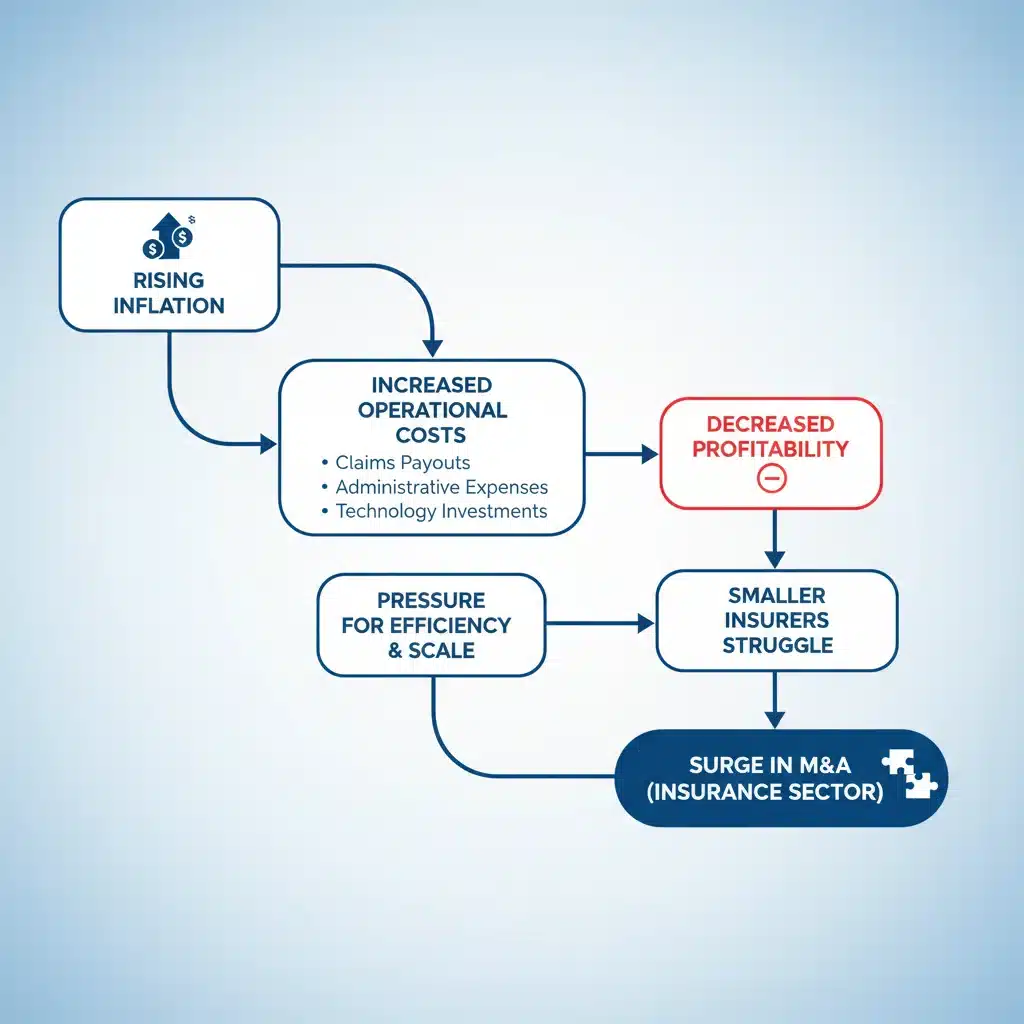
For the insurance industry, inflation presents a multi-faceted challenge. On one hand, it directly impacts the cost of claims. As the price of goods and services rises, so does the cost of repairing damaged property, replacing lost items, and covering medical expenses. This ‘claims inflation’ erodes profitability, as premiums collected often lag behind the escalating costs of payouts. On the other hand, operational costs for insurers themselves are also subject to inflationary pressures. Everything from technology infrastructure and employee salaries to regulatory compliance and marketing expenses becomes more expensive, squeezing margins further.
Furthermore, the investment portfolios of insurance companies, which are crucial for generating returns to offset claims and operational costs, can also be negatively affected by inflation. While certain asset classes may perform well, the overall impact can be a reduction in real returns, making it harder for insurers to meet their financial obligations and shareholder expectations. This complex interplay of rising costs and potentially diminishing real returns creates an environment where smaller, less diversified insurers find it increasingly difficult to compete and maintain profitability.
The pressure to maintain financial stability and deliver shareholder value in such an environment becomes immense. This is where insurance sector consolidation emerges as a strategic imperative. By merging with or acquiring other entities, insurers can achieve greater economies of scale, reduce redundant operational costs, enhance their market share, and diversify their risk exposure. This proactive response to inflationary headwinds is expected to be a dominant theme in the insurance landscape leading up to and through 2026.
Key Drivers of Increased Insurance Sector Consolidation
The projected 5% increase in insurance sector consolidation by 2026 is not a singular event but rather the culmination of several interconnected drivers, all exacerbated by inflation. Understanding these drivers provides a clearer picture of the strategic motivations behind the anticipated wave of mergers and acquisitions (M&A).
1. Economies of Scale and Cost Efficiencies
In an inflationary environment, every dollar saved on operational costs directly contributes to improved profitability. Larger entities naturally benefit from greater economies of scale. By consolidating, insurers can eliminate redundant functions, streamline processes, centralize back-office operations, and negotiate better terms with suppliers and technology vendors. This reduction in per-unit cost of operations is a powerful incentive, especially when revenue growth through premium increases might be limited by market competitiveness or regulatory constraints. The ability to spread fixed costs over a larger premium base becomes critical for survival and growth.
2. Enhanced Pricing Power and Market Share
Consolidation often leads to larger, more dominant players in the market. With increased market share comes enhanced pricing power. While regulatory bodies monitor for anti-competitive practices, a larger footprint can allow insurers to better absorb cost increases before passing them on to consumers, or to implement necessary premium adjustments more effectively. This is particularly relevant in segments where competition is fierce and margins are thin. A stronger market position also provides a buffer against competitive pressures and allows for more strategic product development.
3. Diversification of Risk and Product Portfolios
Inflationary pressures can disproportionately affect certain lines of business. For example, property and casualty insurance might be more exposed to claims inflation related to construction costs, while life insurance might face challenges with investment returns. Through consolidation, insurers can diversify their risk exposure across different geographical regions, product lines, and customer segments. This diversification acts as a hedge against localized economic downturns or sector-specific inflationary spikes, leading to a more stable and resilient overall business model. It also allows for cross-selling opportunities and a broader appeal to a wider customer base.
4. Technology and Digital Transformation Imperatives
The insurance industry is in the midst of a significant digital transformation. Investing in cutting-edge technologies like AI, machine learning, big data analytics, and cloud computing is no longer optional but a necessity for efficiency, customer experience, and competitive advantage. However, these investments are substantial. Smaller insurers often lack the capital and resources to undertake such transformations independently. Consolidation provides the necessary financial muscle and talent pool to accelerate digital initiatives, ensuring that the combined entity remains competitive and innovative in a rapidly evolving technological landscape. This is about more than just cost savings; it’s about future-proofing the business.
5. Regulatory and Compliance Burden
The regulatory environment for insurance companies is becoming increasingly complex and stringent globally. Compliance with new data privacy laws, solvency requirements, and consumer protection regulations demands significant investment in legal, compliance, and IT infrastructure. For smaller insurers, meeting these escalating demands can be a disproportionate burden. Larger, consolidated entities can leverage their greater resources to manage regulatory complexities more efficiently, distributing the cost of compliance across a wider operational base. This often makes M&A an attractive option for smaller players struggling to keep pace with regulatory changes.
6. Talent Acquisition and Retention
The insurance industry, like many others, faces a talent crunch, particularly in specialized areas such as data science, cybersecurity, and advanced actuarial analysis. Attracting and retaining top talent in an inflationary environment, where wage expectations are higher, can be challenging for smaller firms. Larger, consolidated entities often offer more robust career development opportunities, better benefits packages, and a more diverse range of projects, making them more attractive employers. M&A can thus be a strategy to acquire critical talent along with the business assets, strengthening the combined workforce.
Anticipated Impact of Increased Consolidation on the Insurance Sector
The projected 5% increase in insurance sector consolidation will undoubtedly have far-reaching consequences, reshaping the competitive landscape, influencing product offerings, and affecting various stakeholders. These impacts will be felt across the entire ecosystem, from customers to employees and investors.
For Consumers: Potential Benefits and Drawbacks
For policyholders, the effects of consolidation can be mixed. On the positive side, larger insurers resulting from mergers might be able to offer more competitive pricing due to their greater efficiency and economies of scale. They may also have broader product portfolios, offering more comprehensive coverage options and innovative digital services. Improved financial stability of larger entities could also translate to greater security for policyholders.
However, there are potential drawbacks. Reduced competition in certain markets could lead to fewer choices and potentially less innovative product development over time. There’s also a risk that larger, more bureaucratic organizations might offer less personalized customer service, although many consolidated entities strive to maintain high service standards through technological advancements. The challenge for regulators will be to ensure that consolidation does not unduly harm consumer interests.
For Employees: Opportunities and Challenges
For employees within the merging entities, consolidation presents both opportunities and challenges. On one hand, it can open up new career paths, offer exposure to a wider range of projects, and potentially lead to better compensation and benefits packages within a larger organization. Employees in acquiring companies might see their roles expand or gain access to more resources.
On the other hand, consolidation often leads to job redundancies, particularly in overlapping administrative and support functions. This can create uncertainty and anxiety among the workforce. Successful integration strategies will be crucial to mitigate these negative impacts, focusing on retraining, redeployment, and clear communication to retain valuable talent and maintain morale.
For Investors and Shareholders: Value Creation and Risk Management
For investors, insurance sector consolidation is typically viewed as a strategy for value creation. The promise of cost synergies, increased market share, and diversified revenue streams can lead to higher profitability and improved shareholder returns. Well-executed mergers can unlock significant value, making the combined entity more attractive to institutional investors.
However, M&A also carries inherent risks, including integration challenges, cultural clashes, and the potential for overpaying for acquisitions. Inflationary pressures, while driving consolidation, also introduce volatility and uncertainty into valuations. Investors will be closely scrutinizing the strategic rationale and execution capabilities of merging entities to ensure that the anticipated benefits materialize and that risks are effectively managed.
For the Broader Insurance Market: Reshaping the Competitive Landscape
The increased pace of insurance sector consolidation will inevitably reshape the overall competitive landscape. We can expect to see fewer, but more robust and technologically advanced, insurance entities. This could lead to a more concentrated market, potentially impacting smaller, niche insurers who may find it harder to compete on scale or price. There might also be a rise in specialized insurers focusing on unique risks or customer segments that larger players overlook.
The role of insurtech companies will also be critical. While some may be acquired by larger insurers looking to enhance their technological capabilities, others might thrive by offering agile, innovative solutions that complement or challenge the offerings of consolidated giants. The market will become more polarized, with a clear distinction between large, diversified players and highly specialized, agile firms.
Strategic Responses for Insurers in an Inflationary and Consolidating Market
In the face of persistent inflationary pressures and an accelerating trend of insurance sector consolidation, insurers must adopt proactive and strategic responses to ensure their long-term viability and growth. Passivity is not an option in such a dynamic environment.
1. Embrace Digital Transformation and Automation
Digital transformation is no longer a buzzword; it’s a survival imperative. Insurers must invest heavily in automation, AI, and data analytics to streamline operations, reduce manual errors, and enhance efficiency. Automating claims processing, underwriting, and customer service can significantly lower operational costs, thereby mitigating the impact of inflation. Advanced analytics can also provide deeper insights into claims trends, allowing for more accurate pricing and risk assessment, which is crucial when costs are rising.
2. Optimize Underwriting and Pricing Strategies
In an inflationary environment, traditional underwriting models may become outdated quickly. Insurers need to develop more agile and dynamic pricing strategies that can respond swiftly to escalating claims costs and economic shifts. This involves leveraging real-time data, predictive analytics, and scenario modeling to ensure that premiums accurately reflect the true cost of risk. Furthermore, exploring parametric insurance solutions, where payouts are triggered by predefined events rather than actual loss assessment, could offer a hedge against claims inflation in certain areas.
3. Focus on Expense Management and Cost Reduction
Beyond digital transformation, a rigorous focus on overall expense management is critical. This includes scrutinizing every aspect of the cost base, from vendor contracts and supply chain efficiency to real estate utilization and workforce management. Identifying areas for cost reduction without compromising service quality or strategic growth initiatives will be paramount. This might involve renegotiating terms with reinsurers, optimizing investment portfolios for inflation-adjusted returns, and exploring shared service models.
4. Strategic Partnerships and Alliances
For insurers not actively pursuing large-scale M&A, strategic partnerships and alliances can offer many of the benefits of consolidation without full integration. Collaborating with insurtechs for specific technological solutions, forming joint ventures for market expansion, or partnering with other insurers for shared services can provide access to new capabilities, markets, and cost efficiencies. These partnerships can be a flexible way to enhance competitive positioning and mitigate inflationary pressures.
5. Talent Development and Retention
In a consolidating market, attracting and retaining top talent becomes even more challenging. Insurers need to invest in robust talent development programs, offer competitive compensation and benefits, and foster a positive organizational culture. The focus should be on upskilling existing employees in new technologies and analytics, as well as creating an attractive environment for new recruits. A strong talent base is a crucial asset, especially when facing complex economic headwinds and the demands of integration.
6. Customer-Centric Innovation
Even amidst cost pressures and consolidation, maintaining a strong customer focus is vital. Insurers must continue to innovate their product offerings and service delivery to meet evolving customer needs. This could involve personalized insurance products, seamless digital customer journeys, and enhanced communication channels. Loyalty and retention become even more important when market competition is intense, and customers are sensitive to price changes driven by inflation.

Case Studies and Examples of Inflation-Driven Consolidation
While 2026 is still on the horizon, the patterns of insurance sector consolidation driven by economic pressures are not new. Historical precedents and recent trends offer valuable insights into what the future might hold. For instance, periods of high inflation in the past have often seen smaller, less capitalized insurers struggling to maintain solvency, leading to distressed sales or strategic acquisitions by larger, more resilient players.
Consider the European market, where increasing regulatory burdens (like Solvency II) combined with low interest rates (and now potential inflation) have already spurred significant M&A activity. Larger groups acquired smaller, regional players to achieve compliance scale and operational efficiencies. Similarly, in the US, regional carriers have often been targets for national insurers looking to expand their geographic footprint and diversify their risk portfolios. These acquisitions are frequently underpinned by the desire to spread fixed costs and leverage technology investments across a broader customer base, precisely the motivations amplified by inflation.
More recently, the rise of insurtech has also played a dual role. While some insurtechs have disrupted traditional models, many have become attractive acquisition targets for established insurers seeking to rapidly integrate new technologies and digital capabilities without the extensive in-house development. This trend is likely to accelerate as inflationary pressures make it harder for individual insurers to fund large-scale tech overhauls on their own.
The projected 5% increase specifically points to a heightened intensity of these existing trends. It suggests that the inflationary environment of 2026 will push more companies, even those that might have previously resisted M&A, towards considering consolidation as a primary strategic lever to navigate economic headwinds. This will likely involve a mix of horizontal mergers (companies in the same market), vertical integration (acquiring distributors or service providers), and even conglomerate mergers (diversifying into related financial services).
The Role of Regulators and Policy Makers
As insurance sector consolidation accelerates, the role of regulators and policymakers becomes increasingly critical. Their primary objective will be to balance the potential benefits of consolidation (such as increased financial stability and efficiency) against the risks of reduced competition, potential harm to consumers, and systemic risk concentration.
Regulators will need to closely monitor M&A activity to prevent anti-competitive practices that could lead to higher premiums or reduced choice for policyholders. This involves thorough antitrust reviews and potentially imposing conditions on mergers to ensure fair market conduct. Furthermore, they will need to adapt existing regulatory frameworks to address the complexities of larger, more interconnected insurance groups, ensuring adequate capital requirements and robust risk management practices.
Policymakers also have a role in creating an environment that encourages healthy competition while allowing for necessary industry evolution. This might involve supporting innovation, fostering a level playing field for smaller players, and ensuring that regulatory burdens do not disproportionately impact certain segments of the market. The goal is to facilitate an insurance market that remains resilient, innovative, and serves the best interests of its policyholders, even amidst significant economic shifts.
Conclusion: Navigating the Future of Insurance in 2026
The projected 5% increase in insurance sector consolidation by 2026, driven by pervasive inflationary pressures, signals a transformative period for the industry. This is not merely a cyclical trend but a fundamental response to a challenging economic environment where rising costs, technological demands, and regulatory complexities converge.
Insurers that proactively embrace digital transformation, optimize their underwriting and pricing, rigorously manage expenses, and strategically consider partnerships or M&A opportunities will be best positioned to thrive. The landscape of 2026 will likely feature fewer, but more robust and technologically advanced, insurance entities. While consolidation offers pathways to efficiency and resilience, it also presents challenges related to market concentration, employee integration, and maintaining customer focus. Navigating these complexities will require astute leadership, innovative strategies, and a deep understanding of the evolving economic currents. The future of insurance will be defined by adaptation, scale, and a relentless pursuit of value in an increasingly inflationary world.