
In the complex world of insurance, where jargon often obscures clarity and premiums seem to steadily climb, one crucial element holds significant power over your annual expenses: the deductible. For U.S. policyholders, understanding and strategically managing your insurance deductible savings can lead to substantial financial benefits, potentially reducing your premiums by up to 20% each year. This isn’t about cutting corners; it’s about smart financial planning, informed decision-making, and taking control of your insurance costs. This comprehensive guide will demystify deductibles, explore their impact on your premiums, and equip you with actionable strategies to maximize your savings.
Insurance is a fundamental pillar of financial security, protecting us from unforeseen events that could otherwise lead to catastrophic financial loss. Whether it’s auto, home, health, or other forms of coverage, the underlying principle remains the same: you pay a regular premium, and in exchange, the insurer agrees to cover specific losses beyond a certain threshold – your deductible. Many policyholders view the deductible as a fixed cost, an unavoidable hurdle before their coverage kicks in. However, this perspective overlooks the dynamic relationship between your deductible and your premium, a relationship that, when understood, becomes a powerful tool for insurance deductible savings.
Understanding the Deductible: Your Share of the Risk
Before diving into savings strategies, it’s essential to have a crystal-clear understanding of what a deductible truly is. Simply put, a deductible is the amount of money you, the policyholder, must pay out-of-pocket before your insurance company starts paying for a covered loss. It’s your initial contribution towards a claim. For example, if you have a $1,000 deductible on your auto insurance and you get into an accident that causes $3,000 in damage, you would pay the first $1,000, and your insurer would cover the remaining $2,000.
Deductibles vary significantly depending on the type of insurance and the specific policy. They can be a fixed dollar amount (common in auto and home insurance), a percentage of the insured value (often seen in wind or hurricane deductibles for homeowners), or even a combination. Understanding these nuances is the first step toward unlocking insurance deductible savings.
Why Deductibles Exist
Deductibles serve several crucial purposes for insurance companies:
- Risk Sharing: They ensure that policyholders share some of the financial responsibility for a loss, preventing them from filing small claims for minor incidents.
- Moral Hazard Reduction: By requiring policyholders to pay a portion of the claim, deductibles discourage reckless behavior and excessive claims.
- Premium Management: Deductibles allow insurers to offer lower premiums. The higher your deductible, the less risk the insurance company assumes for smaller claims, and therefore, the lower your premium. This is the core principle we’ll leverage for insurance deductible savings.
- Administrative Cost Reduction: They reduce the number of small claims, thereby cutting down on the administrative costs associated with processing them.
The Inverse Relationship: Deductibles and Premiums
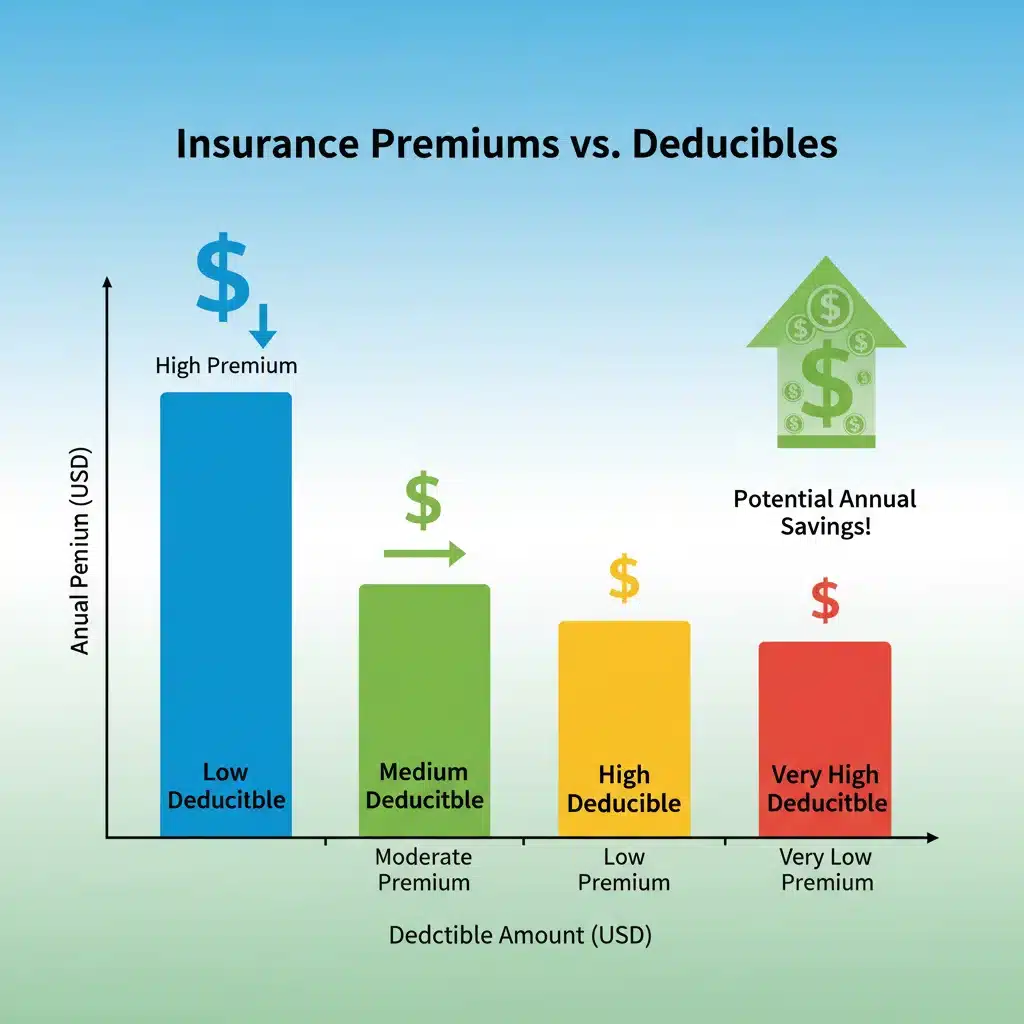
The most fundamental concept to grasp for maximizing your insurance deductible savings is the inverse relationship between your deductible amount and your insurance premium. Generally, the higher your deductible, the lower your premium, and vice-versa. This is not a coincidence; it’s a direct reflection of the risk transfer between you and the insurer.
When you choose a higher deductible, you’re essentially telling your insurance company, “I’m willing to bear more of the initial financial burden if something goes wrong.” In return for taking on more of that risk, the insurer charges you less for your coverage. This can translate into significant annual insurance deductible savings.
Consider this: a small increase in your deductible might lead to a substantial percentage decrease in your monthly or annual premium. Over the lifespan of your policy, these savings can accumulate to thousands of dollars. The key is to find the sweet spot – a deductible you can comfortably afford to pay out-of-pocket should a claim arise, while still enjoying the benefit of lower premiums.
Example Scenario: Auto Insurance
Let’s illustrate with a hypothetical auto insurance example:
- Policy A: $500 deductible, Premium: $1,200/year
- Policy B: $1,000 deductible, Premium: $1,000/year
- Policy C: $2,500 deductible, Premium: $800/year
In this scenario, by moving from a $500 deductible to a $2,500 deductible, you could save $400 per year, which is a 33% reduction in premium. This significant difference highlights the potential for insurance deductible savings.
Strategies for Maximizing Your Insurance Deductible Savings
Now that we understand the basics, let’s explore actionable strategies to leverage your deductible for maximum insurance deductible savings.
1. Assess Your Financial Comfort Level and Emergency Fund
Before you even consider raising your deductible, honestly assess your financial situation. Can you comfortably afford to pay a higher deductible out-of-pocket if an incident occurs? This is paramount. There’s no benefit in saving on premiums if a claim forces you into financial distress because your deductible is too high.
- Emergency Fund: A robust emergency fund is your best friend when it comes to higher deductibles. Ideally, you should have at least 3-6 months’ worth of living expenses saved. If your emergency fund can easily cover your chosen deductible amount, then a higher deductible might be a viable option for insurance deductible savings.
- Risk Tolerance: Consider your personal risk tolerance. Are you comfortable with the idea of paying a larger sum upfront in exchange for lower monthly costs?
2. Shop Around and Compare Quotes
This might seem obvious, but many policyholders stick with the same insurer for years without comparing quotes. Insurance companies have different underwriting criteria, and what one company considers a high risk, another might view more favorably. Obtain quotes from multiple providers with varying deductible amounts for the same coverage levels. This will give you a clear picture of the potential insurance deductible savings available in the market.
3. Understand Different Deductible Types
Deductibles aren’t always straightforward. Familiarize yourself with the various types:
- Standard Deductible: A fixed dollar amount for most claims (e.g., auto collision, comprehensive, home damage).
- Percentage Deductibles: Common in homeowners insurance for specific perils like wind, hail, or hurricanes. For example, a 2% hurricane deductible on a $300,000 home means a $6,000 deductible. Be very aware of these, as they can be significantly higher than fixed-dollar deductibles.
- Aggregate Deductibles: Often found in health insurance, where all covered medical expenses contribute to one overall deductible amount for a given period.
- Per-Claim vs. Per-Year Deductibles: Most auto and home insurance deductibles are per-claim, meaning you pay it each time you file a claim. Some health insurance plans have annual deductibles.
Knowing these distinctions is crucial for accurately calculating potential insurance deductible savings.
4. Review Your Claim History
How often do you typically file claims? If you have a history of frequent, small claims (e.g., minor fender benders, small home repairs), a very high deductible might not be the best strategy, as you could end up paying the deductible multiple times. However, if you rarely file claims, opting for a higher deductible could yield substantial insurance deductible savings over time.
5. Consider Your Asset Value and Replacement Costs
For home and auto insurance, consider the actual value of your assets. If you have an older car with a low market value, a very high deductible might mean that in the event of a total loss, the deductible consumes a significant portion of the payout. Conversely, for a newer, more expensive vehicle or a valuable home, a higher deductible might be more manageable in relation to the overall replacement cost.
6. Bundle Your Policies
While not directly related to deductibles, bundling multiple insurance policies (e.g., auto and home) with the same insurer often results in significant multi-policy discounts. These discounts, when combined with strategic deductible choices, can amplify your overall insurance deductible savings.
7. Maintain a Good Driving Record and Home Maintenance
Your behavior directly impacts your insurance risk profile. A clean driving record, a well-maintained home, and proactive safety measures can lead to lower premiums, making it easier to absorb a higher deductible if needed, and further contributing to your insurance deductible savings.
8. Consult with an Independent Insurance Agent
An independent insurance agent works with multiple insurance companies and can provide unbiased advice tailored to your specific needs. They can help you compare policies, understand the fine print, and recommend deductible levels that align with your financial situation and risk tolerance. Their expertise can be invaluable in identifying optimal insurance deductible savings opportunities.

When a Higher Deductible Makes Sense for Insurance Deductible Savings
A higher deductible is generally a good strategy if:
- You have a solid emergency fund: You can comfortably cover the deductible amount without financial strain.
- You have a low claims history: You don’t frequently file small claims.
- You’re financially stable: You have a steady income and good financial habits.
- You’re looking for significant premium reductions: You prioritize lower monthly payments over a lower out-of-pocket cost during a claim.
When a Lower Deductible Might Be Preferable
Conversely, a lower deductible might be a better choice if:
- Your emergency fund is limited: You would struggle to pay a large lump sum in an emergency.
- You have a history of frequent claims: You anticipate filing claims more often.
- You prefer predictability: You want to know your out-of-pocket maximum will be relatively small if a claim occurs.
- The premium difference is negligible: Sometimes, the premium savings from a higher deductible might be minimal, making the increased risk not worthwhile.
The Math Behind 20% Annual Savings: A Deeper Dive
Achieving up to 20% in annual insurance deductible savings isn’t an exaggeration; it’s a realistic goal for many U.S. policyholders who proactively manage their insurance. Let’s break down how this can happen across different policy types.
Auto Insurance
For auto insurance, increasing your collision and comprehensive deductibles is often the most direct path to savings. Many drivers opt for $500 or $1,000 deductibles. However, if you increase these to $1,500 or $2,500, the premium reduction can be substantial. For example, moving from a $500 deductible to a $1,000 deductible can often reduce premiums by 5-10%. Going from $500 to $2,500 could yield savings of 15-25% or more, depending on your vehicle, driving record, and location. If your annual premium is $2,000, a 20% saving means $400 back in your pocket each year.
Homeowners Insurance
Homeowners insurance offers similar opportunities. Standard deductibles range from $500 to $2,500. Increasing your standard deductible from, say, $1,000 to $2,500 or even $5,000 can result in significant premium reductions, often in the 10-20% range. For a $1,500 annual premium, a 20% saving is $300. Be particularly mindful of percentage-based deductibles for specific perils (e.g., hurricane, wind/hail). If you live in a high-risk area, these can be substantial. Carefully evaluate if you can absorb a 2% or 5% deductible on your home’s value before opting for higher options for insurance deductible savings.
Health Insurance
Health insurance plans, especially High-Deductible Health Plans (HDHPs), are explicitly designed around the principle of higher deductibles leading to lower premiums. These plans are often paired with Health Savings Accounts (HSAs), offering a triple tax advantage. While the deductibles can be several thousands of dollars, the monthly premium savings compared to traditional plans can be 30-50% or more. If you’re generally healthy and have an emergency fund, an HDHP with a higher deductible can be a powerful tool for insurance deductible savings and long-term financial planning.
Combining Strategies for Maximum Impact
The 20% savings often come from a combination of strategies:
- Optimizing deductibles across all policies: Don’t just look at one policy; review auto, home, umbrella, and even health insurance deductibles.
- Bundling policies: As mentioned, multi-policy discounts amplify savings.
- Leveraging loyalty discounts: Some insurers reward long-term customers.
- Maintaining good credit scores: In many states, credit scores impact insurance premiums.
- Taking advantage of safety features/discounts: Car alarms, home security systems, good student discounts, etc.
By implementing several of these tactics in conjunction with strategic deductible management, achieving or even exceeding 20% in annual insurance deductible savings becomes a very attainable goal.
The Pitfalls to Avoid When Adjusting Deductibles
While the allure of lower premiums is strong, there are potential pitfalls to be aware of when adjusting your deductibles:
- Underestimating Out-of-Pocket Costs: The biggest mistake is setting a deductible you cannot afford. If a claim occurs and you can’t pay your deductible, your insurance company won’t pay its share, leaving you fully responsible for the damages.
- Ignoring Specific Peril Deductibles: Especially in homeowners insurance, don’t overlook separate deductibles for wind, hail, hurricanes, or earthquakes. These can be percentage-based and result in a much higher out-of-pocket cost than your standard deductible.
- Frequent Small Claims: If you tend to file claims for minor incidents, a high deductible might mean you effectively pay for most of the repair yourself, negating any premium savings.
- Not Reviewing Annually: Your financial situation and insurance needs can change. What was a suitable deductible last year might not be this year. Regularly review your policies.
Action Plan: Your Path to Insurance Deductible Savings
Ready to start saving? Follow this step-by-step action plan:
- Inventory Your Policies: Gather all your insurance policy documents (auto, home, health, renters, etc.). Note down your current deductibles and annual premiums for each.
- Assess Your Emergency Fund: Determine how much liquid cash you have readily available for unexpected expenses. Can it cover a higher deductible for each policy?
- Research Potential Deductible Increases: For each policy, contact your current insurer(s) and ask for quotes with higher deductible options. For example, if you have a $500 auto deductible, ask for quotes with $1,000, $1,500, and $2,500. Note the premium savings for each.
- Get Competitive Quotes: Don’t stop at your current insurer. Use online comparison tools or work with an independent agent to get quotes from at least 3-5 other insurance companies for the same coverage levels but with varying deductibles.
- Calculate Break-Even Points: For each potential deductible increase, calculate how long it would take for the premium savings to offset the increased deductible amount. For instance, if increasing your deductible by $500 saves you $100 per year, it would take 5 years to break even. If you don’t anticipate filing a claim within that period, it might be a worthwhile move for insurance deductible savings.
- Read the Fine Print: Understand all terms and conditions, especially for percentage deductibles or specific peril clauses.
- Make an Informed Decision: Based on your financial comfort, risk tolerance, and the potential insurance deductible savings, choose the deductible levels that best suit your situation.
- Implement and Monitor: Adjust your policies. Then, remember to revisit this process annually during your policy renewal period or whenever significant life changes occur (e.g., new job, marriage, new home).
Conclusion: Empowering Your Financial Future
The deductible is more than just a hurdle; it’s a powerful lever in your financial toolkit. By actively engaging with your insurance policies and making informed decisions about your deductibles, you can unlock significant annual insurance deductible savings – potentially up to 20% or more. This not only puts more money back into your pocket but also fosters a deeper understanding of your financial responsibilities and risk management. Don’t let inertia dictate your insurance costs. Take control, assess your options, and strategically adjust your deductibles to build a more secure and cost-effective financial future.
Remember, the goal is not simply to pay the lowest premium, but to find the optimal balance between affordable coverage and manageable out-of-pocket expenses. With careful planning and a clear understanding of your options, those substantial insurance deductible savings are well within your reach.