Deductibles and Premiums: Understanding Your Health Insurance Costs

Navigating the world of health insurance can often feel like deciphering a complex code. Two terms that frequently surface and hold significant weight in determining your overall healthcare expenses are ‘deductibles’ and ‘premiums’. Understanding these fundamental concepts is not just about jargon; it’s about empowering yourself to make informed decisions that can impact your out-of-pocket costs by an average of 15% or more, depending on your plan and usage. This comprehensive guide aims to demystify these crucial elements of your health insurance policy, helping you gain clarity and control over your health insurance costs.
When you sign up for a health insurance plan, you’re entering into an agreement with an insurance company. In exchange for regular payments, known as premiums, the insurer agrees to cover a portion of your medical expenses. However, before that coverage kicks in fully, you typically need to meet a deductible. These two components, along with co-pays and co-insurance, form the financial backbone of your health coverage. A deep dive into each will reveal how they interact and what that means for your wallet.
What are Health Insurance Premiums?
Let’s start with premiums, as they are often the most straightforward concept to grasp. Your health insurance premium is the amount of money you pay to your insurance company for coverage. This payment is usually made monthly, but can also be quarterly or annually, depending on your plan and payment schedule. Think of it as a subscription fee for your health coverage. Whether you use medical services or not, you must pay your premium to keep your insurance active.
Factors Influencing Your Premium
Several factors can influence the amount you pay for your health insurance premiums:
- Age: Generally, premiums tend to be higher for older individuals.
- Location: Healthcare costs vary by region, which can affect premium rates.
- Tobacco Use: Smokers may face higher premiums due to increased health risks.
- Plan Type: Different types of plans (e.g., HMO, PPO, POS, EPO) come with varying premium levels.
- Number of Dependents: Adding family members to your plan will increase your premium.
- Metal Tier: Plans are categorized into metal tiers (Bronze, Silver, Gold, Platinum) based on how they split costs with you. Bronze plans typically have the lowest premiums but highest out-of-pocket costs, while Platinum plans have the highest premiums but lowest out-of-pocket costs.
It’s important to note that under the Affordable Care Act (ACA), insurance companies cannot charge different premiums based on gender or pre-existing conditions. This levels the playing field for many individuals seeking coverage.
Understanding Health Insurance Deductibles
Now, let’s tackle deductibles. Your health insurance deductible is the amount of money you must pay out of your own pocket for covered medical services before your insurance company starts to pay. For instance, if you have a $2,000 deductible, you are responsible for the first $2,000 of your medical bills for services covered by your plan. Once you’ve paid that $2,000, your insurance company will then begin to pay its share of the costs, usually in the form of co-insurance.
How Deductibles Work in Practice
Imagine you have a health insurance plan with a $2,000 deductible. You get sick and visit the doctor, incur lab fees, and need a prescription. The total cost of these services is $500. You pay the full $500. Later in the year, you have an unexpected injury that requires an emergency room visit and follow-up care, totaling $3,000. Since you’ve already paid $500 towards your deductible, you now need to pay another $1,500 to reach your $2,000 deductible. After you’ve paid that $1,500, your deductible is met. For the remaining $1,500 of the $3,000 injury cost, your insurance will start to pay its portion, and you’ll pay your co-insurance until you reach your out-of-pocket maximum.
Types of Deductibles
- Individual Deductible: This applies to a single person on a plan.
- Family Deductible: For plans covering multiple people, this is the total amount that must be met by all family members before the insurance starts paying for anyone on the plan. Some family deductibles operate on a ‘per-person’ basis until a family maximum is met, while others are an aggregate sum.
- Separate Deductibles: Some plans might have separate deductibles for different types of services, such as a separate deductible for prescription drugs or for in-network vs. out-of-network care.
It’s crucial to understand that not all medical expenses count towards your deductible. Typically, preventive care services, like annual physicals and certain screenings, are covered by insurance at 100% before you meet your deductible, thanks to the ACA. However, co-pays for doctor visits may or may not count towards your deductible, depending on your specific plan.
The Interplay: Premiums vs. Deductibles
This is where the real strategic thinking comes into play when choosing a health insurance plan. There’s an inverse relationship between premiums and deductibles:
- High Deductible Plans: These plans typically come with lower monthly premiums. In exchange for paying less each month, you’ll have a higher deductible to meet before your insurance starts contributing significantly. These plans are often attractive to individuals who are generally healthy and anticipate needing minimal medical care. They are also frequently paired with Health Savings Accounts (HSAs), which offer tax advantages for saving for medical expenses.
- Low Deductible Plans: Conversely, plans with lower deductibles usually have higher monthly premiums. You pay more upfront each month, but when you do need medical care, your insurance coverage kicks in sooner. These plans are often preferred by individuals or families who anticipate frequent medical needs or have chronic conditions that require ongoing treatment.
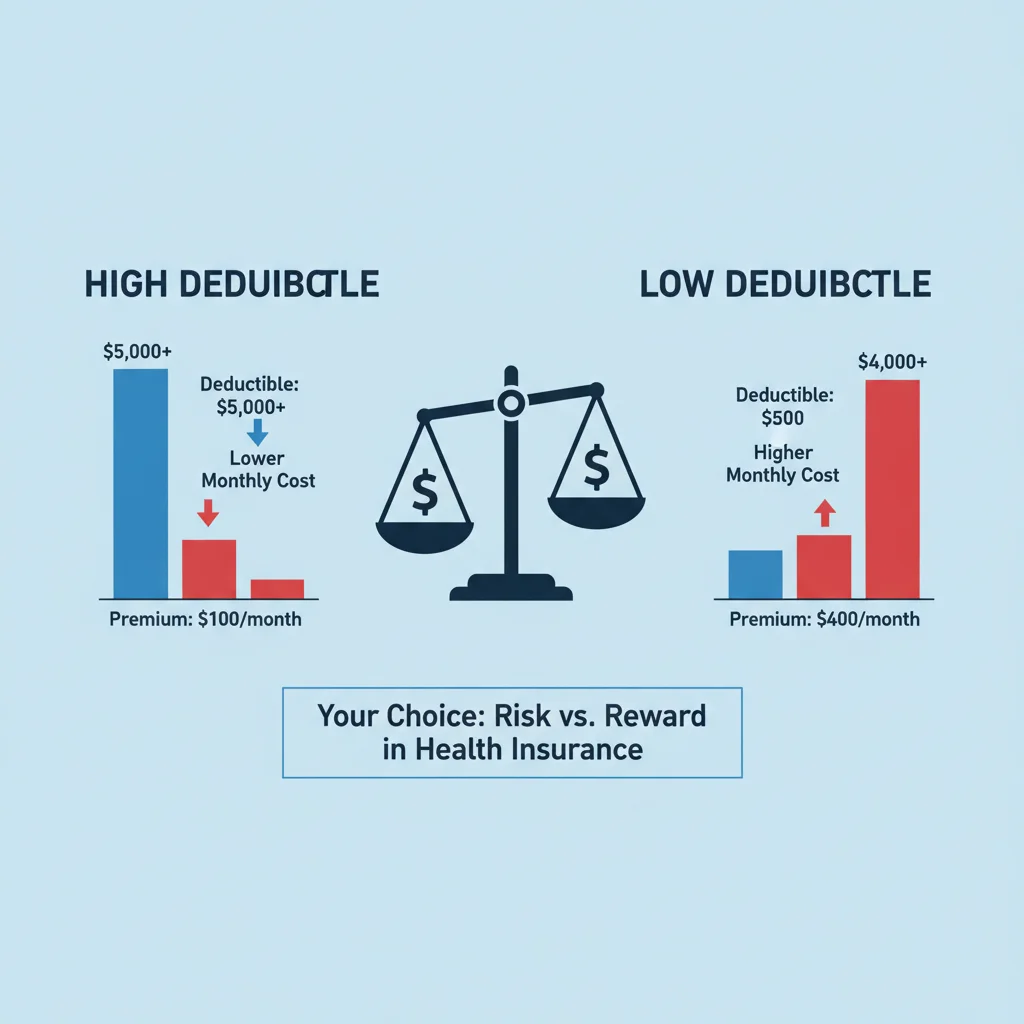
Choosing between these two extremes depends heavily on your personal health situation, financial stability, and risk tolerance. It’s a balance between predictable monthly costs (premiums) and potentially unpredictable out-of-pocket expenses (deductibles and co-insurance).
Beyond Deductibles and Premiums: Co-pays and Co-insurance
While deductibles and premiums are central, two other terms are vital for a complete understanding of your health insurance costs:
Co-pay (Co-payment)
A co-pay is a fixed amount you pay for a covered healthcare service after you’ve paid your deductible (though some plans may have co-pays before the deductible is met for certain services like doctor visits). For example, you might have a $30 co-pay for a doctor’s visit or a $50 co-pay for an emergency room visit. Co-pays typically do not count towards your deductible, but they do often count towards your out-of-pocket maximum.
Co-insurance
Co-insurance is your share of the cost for a covered healthcare service, calculated as a percentage of the allowed amount for the service. This kicks in after you’ve met your deductible. For example, if your plan has an 80/20 co-insurance, it means your insurance pays 80% of the cost, and you pay 20% until you reach your out-of-pocket maximum. If a service costs $100 after your deductible is met, and you have 20% co-insurance, you would pay $20, and your insurance would pay $80.
The Out-of-Pocket Maximum: Your Financial Safety Net
The out-of-pocket maximum (or out-of-pocket limit) is perhaps the most critical number to understand. This is the absolute most you will have to pay for covered medical services in a given policy year. Once you reach this limit, your insurance company will pay 100% of the cost of all covered services for the remainder of the year.
Your out-of-pocket maximum includes everything you pay towards your deductible, co-pays, and co-insurance. It does not include your monthly premiums. This limit provides a crucial financial safety net, ensuring that even in the event of a catastrophic illness or injury, your medical bills won’t bankrupt you.
Example of How It All Works Together
Let’s tie all these concepts together with an example:
- Premium: $400/month
- Deductible: $3,000
- Co-insurance: 80/20
- Out-of-Pocket Maximum: $6,000
Scenario: You have a medical emergency that results in $10,000 in covered medical expenses in one year.
- Monthly Premiums: You pay $400 each month, totaling $4,800 for the year. (This does not count towards your deductible or out-of-pocket max).
- Deductible: You are responsible for the first $3,000 of the $10,000 bill. You pay this amount.
- Co-insurance: After meeting your $3,000 deductible, there’s $7,000 remaining ($10,000 – $3,000). Your 20% co-insurance on this amount would be $1,400 (20% of $7,000).
- Total Out-of-Pocket: So far, you’ve paid $3,000 (deductible) + $1,400 (co-insurance) = $4,400.
- Out-of-Pocket Maximum Check: Your total out-of-pocket expenses ($4,400) are less than your $6,000 out-of-pocket maximum. Therefore, you pay the $4,400, and your insurance covers the rest of the $10,000 bill (which is $5,600).
If your expenses continued to rise, say to $20,000, you would continue to pay your 20% co-insurance until your total out-of-pocket expenses (deductible + co-insurance + co-pays) reached $6,000. After that, the insurance company would pay 100% of all further covered medical costs for that year.
Strategies for Managing Your Health Insurance Costs
Understanding the basics is the first step; now, let’s explore strategies to effectively manage your health insurance costs.
1. Evaluate Your Health Needs Annually
Your health needs can change from year to year. Take time during open enrollment to honestly assess your anticipated medical usage:
- Do you have any chronic conditions requiring regular doctor visits or prescriptions?
- Are you planning to have surgery or a baby in the coming year?
- Are you generally healthy and rarely visit the doctor?
This assessment will help you decide if a high-deductible plan with lower premiums or a low-deductible plan with higher premiums is more suitable.
2. Understand Your Plan’s Network
Most health insurance plans have a network of preferred providers (doctors, hospitals, pharmacies). Staying within your plan’s network can significantly reduce your costs, as out-of-network care often incurs higher deductibles, co-insurance, or may not be covered at all. Always verify if a provider is in-network before scheduling an appointment.
3. Utilize Preventive Care
As mentioned, many preventive services are covered 100% by insurance, even before you meet your deductible. Taking advantage of annual physicals, screenings, and immunizations can help detect potential health issues early, often preventing more serious and costly conditions down the line.
4. Consider an HSA or FSA
- Health Savings Account (HSA): If you have a high-deductible health plan (HDHP), you may be eligible for an HSA. This is a tax-advantaged savings account that can be used for qualified medical expenses. Contributions are tax-deductible, funds grow tax-free, and withdrawals for medical expenses are also tax-free. It’s a powerful tool for managing future medical costs.
- Flexible Spending Account (FSA): An FSA is similar but can be offered with any health plan. It allows you to set aside pre-tax money from your paycheck to pay for eligible out-of-pocket healthcare costs. The main difference is that HSAs are portable and roll over year to year, while FSAs typically have a ‘use-it-or-lose-it’ rule (though some allow a small rollover or grace period).
5. Shop Around During Open Enrollment
Don’t just auto-renew your plan. Each year during open enrollment, compare different plans available to you. Even if your current plan worked well, new options might offer better coverage or lower health insurance costs for your specific needs. Look at plans from different providers and different metal tiers.
6. Negotiate Medical Bills
If you receive a large medical bill, don’t be afraid to negotiate. Hospitals and providers may be willing to offer a discount, especially if you can pay a portion upfront or set up a payment plan. Always review your bills for errors.
7. Understand Prescription Drug Coverage
Prescription drug costs can be a significant part of your overall healthcare spending. Check your plan’s formulary (list of covered drugs) and understand its tiers. Generic drugs are almost always cheaper than brand-name drugs. Also, explore prescription discount programs or coupons.
8. Use Telehealth Services
For minor ailments or follow-up appointments, telehealth (virtual doctor visits) can often be a more affordable and convenient option than in-person visits, potentially saving on co-pays and travel time.
The Impact on Your Out-of-Pocket Costs
The choice between different deductible and premium structures directly impacts your potential out-of-pocket costs. A study by the Kaiser Family Foundation often indicates that the average annual deductible for single coverage in employer-sponsored plans has steadily increased over the past decade. This trend means consumers are bearing a greater initial financial burden before their insurance coverage fully kicks in. Understanding this relationship is critical:
- Predictability vs. Risk: Higher premiums offer more predictability in monthly budgeting but mean higher fixed annual costs. Lower premiums offer lower fixed costs but expose you to higher financial risk if you need significant medical care before meeting your deductible.
- Budgeting for the Unexpected: Regardless of your plan choice, it’s wise to budget for potential out-of-pocket expenses, especially if you opt for a high-deductible plan. Having an emergency fund specifically for medical costs can prevent financial strain.

On average, individuals who actively manage their plan choices and healthcare utilization can reduce their out-of-pocket medical expenses by an estimated 15% to 25% compared to those who simply stick with the same plan or don’t understand their benefits. This reduction comes from making informed decisions about deductibles, leveraging preventive care, understanding networks, and utilizing tax-advantaged accounts like HSAs.
Conclusion: Taking Control of Your Health Insurance Journey
Deciphering the complexities of health insurance, particularly the concepts of deductibles and premiums, is a fundamental step towards financial wellness. These terms are not just abstract numbers; they are key drivers of your health insurance costs and dictate how much you will pay for your healthcare throughout the year.
By understanding the inverse relationship between premiums and deductibles, along with the roles of co-pays, co-insurance, and the all-important out-of-pocket maximum, you are better equipped to select a plan that aligns with your health needs and financial situation. Remember to regularly review your plan during open enrollment, utilize preventive care, and explore tax-advantaged savings options like HSAs or FSAs. Taking an active role in managing your health insurance is not just about saving money; it’s about ensuring you have access to the care you need without facing unexpected financial burdens. Empower yourself with knowledge, and take control of your healthcare journey.