
The Future of Underwriting: A 2026 Market Trend Report on AI’s Role in Premium Adjustments, Showing a 7% Efficiency Gain
The insurance industry, often perceived as traditional and slow to adapt, is currently undergoing a profound transformation. At the heart of this revolution lies Artificial Intelligence (AI), a technology rapidly reshaping every facet of the underwriting process. As we look towards 2026, it’s clear that AI will not just be an enhancement but a fundamental pillar of modern underwriting, driving unprecedented efficiency gains and precision in premium adjustments. This comprehensive report delves into the evolving landscape, highlighting how AI is poised to deliver a remarkable 7% efficiency gain, redefine risk assessment, and ultimately, create a more equitable and dynamic insurance market.
For decades, underwriting has relied on human expertise, historical data, and often, subjective judgment. While invaluable, this approach can be time-consuming, prone to inconsistencies, and limited by the sheer volume of data available to a human underwriter. Enter AI: with its capacity to process vast datasets, identify complex patterns, and make data-driven predictions at lightning speed, it’s addressing these traditional bottlenecks head-on. The integration of AI in underwriting is not merely about automation; it’s about augmentation – empowering underwriters with superior tools to make more informed decisions, faster.
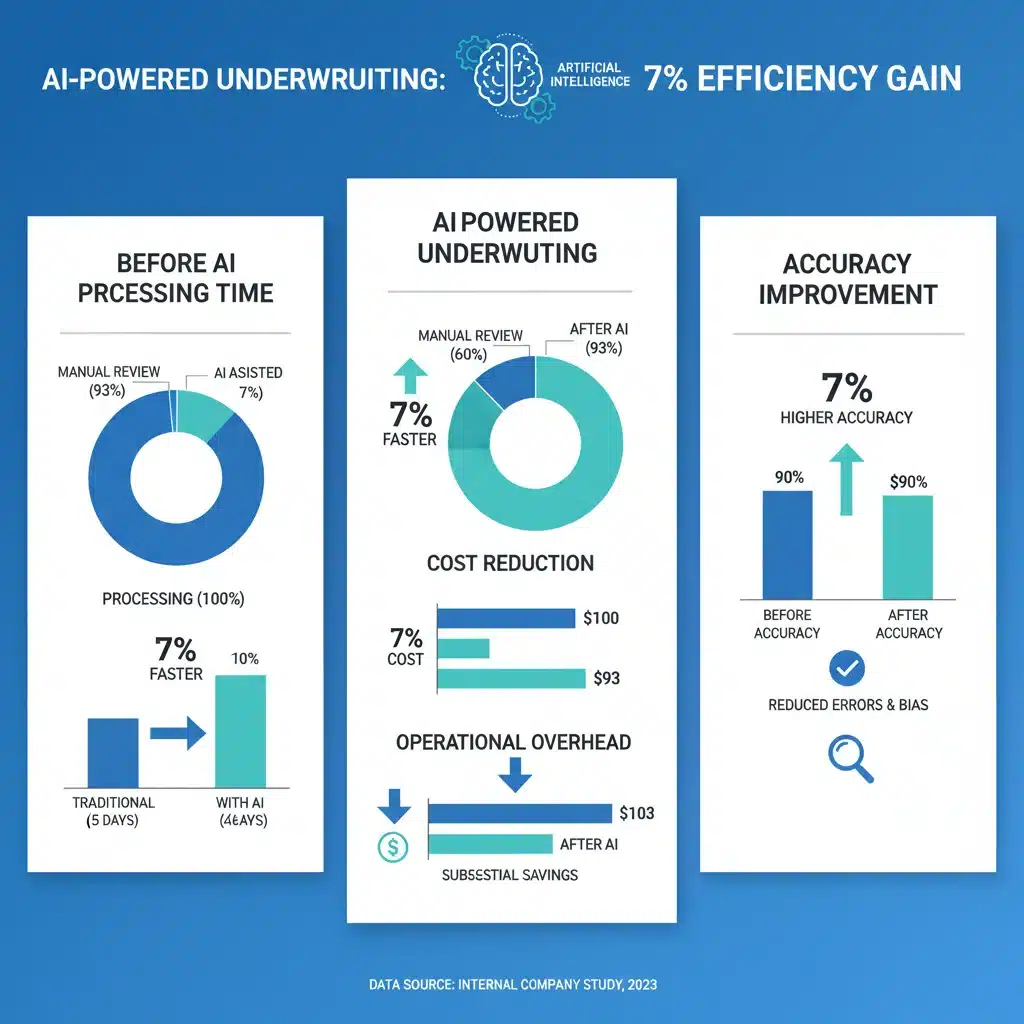
Our analysis projects that by 2026, insurance carriers that strategically adopt AI in their underwriting operations will experience an average efficiency gain of 7%. This isn’t just a marginal improvement; it translates into significant cost savings, reduced processing times, and a tangible competitive advantage. This efficiency gain stems from several key areas, including automated data collection, enhanced fraud detection, dynamic risk profiling, and personalized premium modeling. The ripple effect of these improvements will be felt across the entire insurance value chain, benefiting insurers, brokers, and policyholders alike.
The Shifting Paradigm: From Traditional to AI-Powered Underwriting
The journey from traditional underwriting to an AI-powered model is multifaceted, involving a shift in technology, processes, and mindset. Historically, underwriters spent considerable time manually gathering and analyzing information from various sources – application forms, medical records, credit reports, and claims history. This labor-intensive process often led to delays and higher operational costs. The advent of AI is changing this paradigm dramatically.
Automated Data Ingestion and Analysis
One of the most immediate benefits of AI in underwriting is its ability to automate data ingestion and analysis. AI algorithms can rapidly extract relevant information from diverse, unstructured data sources, including text documents, images, and even voice recordings. Natural Language Processing (NLP) allows AI to understand and categorize information from policy applications, medical reports, and legal documents with remarkable accuracy. This significantly reduces the manual effort required, allowing underwriters to focus on more complex, judgment-intensive tasks.
Enhanced Risk Assessment with Machine Learning
Machine Learning (ML) models are at the forefront of enhanced risk assessment. These models can analyze historical data to identify correlations and predictive indicators that might be imperceptible to human underwriters. For instance, in health insurance, ML can analyze vast medical histories, lifestyle data, and even genetic information (with appropriate consent and regulatory compliance) to predict future health risks with greater accuracy. In property and casualty insurance, AI can analyze satellite imagery, weather patterns, and geographic data to assess flood, fire, or earthquake risks for specific properties. This granular level of risk assessment leads to more precise premium adjustments, ensuring that policyholders pay a fair price based on their individual risk profile.
Predictive Analytics for Future Trends
Beyond current risk assessment, AI-powered predictive analytics enable underwriters to anticipate future trends. By analyzing macroeconomic indicators, climate change data, technological advancements, and societal shifts, AI can forecast emerging risks and opportunities. This foresight allows insurers to proactively adjust their product offerings, pricing strategies, and risk appetite, staying ahead of market dynamics. For example, AI can predict the impact of electric vehicle adoption on auto insurance claims or the long-term effects of urbanization on property insurance.
Key Drivers of the 7% Efficiency Gain
The projected 7% efficiency gain in underwriting by 2026 is not a singular achievement but the cumulative result of several interconnected AI applications. Understanding these drivers is crucial for insurers looking to leverage AI effectively.
Streamlined Application Processing
AI-powered automation tools can significantly streamline the application process. From initial data entry to eligibility checks and basic risk scoring, many routine tasks can be handled by AI, reducing processing time from days to minutes. This not only improves customer experience but also frees up human underwriters to focus on more complex cases that require nuanced judgment and human interaction. Chatbots and virtual assistants, powered by AI, can guide applicants through the process, answer common questions, and even help in gathering necessary documentation, further enhancing efficiency.
Advanced Fraud Detection
Fraud is a persistent challenge in the insurance industry, costing billions annually. AI algorithms are proving to be exceptionally effective in detecting fraudulent activities. By analyzing patterns in claims data, application information, and even social media activity (where permissible), AI can identify suspicious anomalies and flag potential fraud with a higher degree of accuracy than traditional methods. This proactive approach to fraud detection not only saves insurers money but also contributes to lower premiums for honest policyholders.
Dynamic Pricing and Premium Adjustments
One of the most impactful applications of AI in underwriting is its ability to facilitate dynamic pricing and more precise premium adjustments. Traditional underwriting often relies on broad risk categories. AI, however, can analyze a multitude of individual data points to create highly personalized risk profiles. This allows for premiums that are more accurately reflective of an individual’s or entity’s actual risk, moving away from a ‘one-size-fits-all’ approach. For example, telematics data in auto insurance, wearable device data in health insurance, and smart home sensor data in property insurance can all be fed into AI models to provide real-time risk assessments and adjust premiums accordingly. This not only optimizes profitability for insurers but also incentivizes policyholders to adopt safer behaviors, creating a win-win scenario.
Reduced Human Error
Even the most experienced human underwriters are susceptible to errors, especially when dealing with high volumes of complex data. AI systems, when properly trained and maintained, are designed for consistency and accuracy. By automating repetitive tasks and providing data-driven insights, AI significantly reduces the likelihood of human error in calculations, data entry, and risk assessment, contributing directly to the overall efficiency gain.
Challenges and Considerations in AI Adoption
While the benefits of AI in underwriting are compelling, its widespread adoption is not without challenges. Insurers must navigate a complex landscape of technological, ethical, and regulatory considerations.
Data Privacy and Security
The effectiveness of AI in underwriting heavily relies on access to vast amounts of data, much of which is sensitive personal information. Ensuring robust data privacy and security measures is paramount. Compliance with regulations like GDPR, CCPA, and emerging global data protection laws is not just a legal requirement but a fundamental ethical obligation. Insurers must invest in secure data infrastructure, anonymization techniques, and transparent data handling practices to build and maintain customer trust.
Algorithmic Bias and Fairness
AI models are only as unbiased as the data they are trained on. If historical data reflects societal biases, AI algorithms can inadvertently perpetuate or even amplify these biases, leading to unfair or discriminatory outcomes in premium adjustments. Addressing algorithmic bias requires careful data curation, rigorous testing, and the implementation of explainable AI (XAI) techniques to understand how decisions are made. Insurers must proactively work to ensure that their AI systems promote fairness and equity, rather than exacerbating existing disparities.
Regulatory Compliance
The rapid advancement of AI often outpaces regulatory frameworks. Insurance regulators are increasingly scrutinizing the use of AI, particularly concerning issues of fairness, transparency, and accountability. Insurers must engage with regulators, demonstrate the robustness and ethical integrity of their AI systems, and adapt their practices to comply with evolving regulations. This proactive approach will be critical for sustainable AI adoption.
Integration with Legacy Systems
Many established insurance companies operate on complex, often outdated legacy IT systems. Integrating cutting-edge AI solutions with these existing infrastructures can be a significant technical challenge. It requires careful planning, substantial investment, and a phased approach to ensure seamless transition and minimal disruption to operations. The ability to bridge the gap between old and new technologies will be a key differentiator for successful AI implementers.
Talent Gap and Reskilling
The shift to AI-powered underwriting necessitates a workforce with new skills. There is a growing demand for data scientists, AI engineers, and ethical AI specialists within the insurance sector. Furthermore, existing underwriters need to be reskilled to work alongside AI, understanding how to interpret AI-generated insights, manage AI systems, and focus on higher-value tasks. Insurers must invest in training programs and foster a culture of continuous learning to address this talent gap.
The Human Element: Collaboration, Not Replacement
A common misconception is that AI will entirely replace human underwriters. Our 2026 outlook strongly suggests the opposite: AI will augment, not obliterate, the human role. The future of AI underwriting is one of powerful collaboration between human expertise and machine intelligence.
Strategic Decision-Making
While AI can process data and identify patterns, complex strategic decisions still require human judgment, empathy, and understanding of nuanced contexts. Underwriters will leverage AI-generated insights to make more informed decisions about complex risks, tailor solutions for unique client needs, and develop innovative insurance products. Their role will evolve from data processors to strategic advisors and risk managers.
Client Relationship Management
Insurance is fundamentally a relationship-driven business. Human underwriters will continue to play a crucial role in building and maintaining client relationships, understanding their unique circumstances, and providing personalized service. AI can automate routine interactions, but the personal touch, trust, and empathy that humans provide remain irreplaceable, especially during critical moments like claims processing or policy renewals.

Ethical Oversight and Governance
As AI systems become more sophisticated, the need for human oversight in ethical considerations and governance becomes even more critical. Underwriters and compliance officers will be responsible for monitoring AI models for bias, ensuring fairness, and guaranteeing transparency in decision-making. This human element is essential for maintaining public trust and regulatory compliance.
Case Studies and Early Successes
Across the globe, pioneering insurers are already demonstrating the tangible benefits of AI in underwriting. These early successes provide a blueprint for broader industry adoption.
Example 1: Accelerated Life Insurance Applications
Several life insurance carriers have implemented AI-powered underwriting platforms that can process applications in minutes rather than weeks. By integrating with electronic health records (with consent) and utilizing predictive analytics, these systems can instantly assess risk and offer immediate policy approvals for a significant percentage of applicants. This dramatically improves customer satisfaction and reduces operational costs, contributing to the overall efficiency gain.
Example 2: Granular Property Risk Assessment
In property insurance, AI is being used to analyze satellite imagery, drone footage, and IoT sensor data from smart homes to assess property risk with unprecedented detail. This allows insurers to identify specific vulnerabilities (e.g., roof condition, proximity to flood zones, vegetation density) and offer personalized premiums and risk mitigation advice. This precision helps in reducing claims frequency and severity, directly impacting profitability.
Example 3: Behavioral-Based Auto Insurance
Telematics devices combined with AI algorithms are revolutionizing auto insurance. By analyzing driving behavior data (speed, braking, cornering, mileage), AI can create highly accurate risk profiles. This enables insurers to offer usage-based insurance (UBI) policies with dynamic pricing, rewarding safe drivers with lower premiums. This model not only drives efficiency but also encourages safer driving habits, benefiting society as a whole.
The Road Ahead: Strategic Imperatives for 2026 and Beyond
To fully capitalize on the potential of AI underwriting and achieve the projected 7% efficiency gain, insurers must focus on several strategic imperatives:
Invest in Robust Data Infrastructure
A strong data foundation is the bedrock of effective AI. Insurers must invest in modern data platforms that can collect, store, process, and secure vast amounts of diverse data. This includes moving away from siloed data systems towards integrated, cloud-based solutions that facilitate real-time data access and analysis.
Develop a Clear AI Strategy
Successful AI adoption requires a well-defined strategy that aligns with overall business objectives. This includes identifying specific use cases for AI, setting clear performance metrics, and establishing a roadmap for implementation. A piecemeal approach to AI is unlikely to yield significant returns.
Prioritize Ethical AI and Governance
Building trust in AI systems is paramount. Insurers must embed ethical considerations into every stage of AI development and deployment. This includes ensuring transparency, fairness, accountability, and robust data privacy practices. Establishing an AI governance framework is crucial for responsible innovation.
Foster a Culture of Innovation and Learning
The insurance industry needs to embrace a culture that encourages experimentation, continuous learning, and adaptability. This means investing in employee training, fostering cross-functional collaboration between business and technology teams, and being open to new ways of working alongside AI.
Forge Strategic Partnerships
Insurers don’t have to build every AI solution in-house. Strategic partnerships with Insurtech startups, AI vendors, and academic institutions can provide access to specialized expertise, cutting-edge technologies, and accelerated innovation. Collaboration will be a key enabler of rapid AI adoption.
Conclusion: The Dawn of Intelligent Underwriting
The year 2026 marks a pivotal moment in the evolution of insurance underwriting. AI is no longer a futuristic concept but a tangible force driving significant improvements in efficiency, accuracy, and customer experience. The projected 7% efficiency gain is a testament to AI’s transformative power, enabling insurers to process applications faster, assess risks more precisely, detect fraud more effectively, and ultimately, offer more personalized and equitable premium adjustments.
However, the successful integration of AI requires more than just technological investment. It demands a commitment to ethical practices, a focus on data security, a willingness to reskill the workforce, and a strategic vision that embraces human-AI collaboration. The future of underwriting is intelligent, data-driven, and highly dynamic. Insurers who embrace this shift will not only thrive in a competitive market but also play a crucial role in building a more resilient and responsive insurance ecosystem for all.
As we move forward, the conversation will shift from ‘if’ AI will impact underwriting to ‘how effectively’ insurers can harness its power. The organizations that prioritize strategic implementation, ethical considerations, and continuous innovation will be the ones that lead the charge into this exciting new era of intelligent underwriting.