Navigating Insurance Underwriting: Risk Assessment in Today’s Market

Insurance is a cornerstone of modern society, providing a safety net against unforeseen events and financial losses. At the heart of every insurance policy lies a meticulous process known as underwriting. Underwriting is the critical function where insurers assess, evaluate, and ultimately decide whether to accept a risk and, if so, at what price. In an ever-evolving world, understanding the nuances of insurance risk assessment is more vital than ever. This comprehensive guide will delve into the multifaceted role of underwriting in the insurance industry, exploring its historical roots, contemporary practices, and the future landscape of risk evaluation.
The Essence of Underwriting: What is Insurance Risk Assessment?
At its core, underwriting is the process by which an insurance company evaluates the risk of insuring a particular person, property, or operation. It involves analyzing various factors to determine the likelihood of a claim occurring and the potential cost of that claim. The objective is to ensure that the premium charged is commensurate with the level of risk undertaken. This balance is crucial for both the insurer’s profitability and the policyholder’s access to fair and affordable coverage.
Historical Evolution of Insurance Underwriting
The concept of insurance underwriting dates back centuries, with early forms emerging in ancient civilizations. However, modern insurance underwriting began to take shape in the 17th century with the establishment of Lloyd’s of London. Merchants and shipowners would gather in coffee houses, where ‘underwriters’ would literally write their names under the proposed risks they were willing to cover. This early model, though rudimentary by today’s standards, laid the foundation for the systematic evaluation of risk that we see in the insurance industry today.
Over time, underwriting evolved from intuitive judgment to a more scientific discipline, incorporating actuarial science, statistics, and later, advanced data analytics. The industrial revolution, world wars, and technological advancements each brought new complexities and demands, pushing underwriters to refine their methods and adapt to emerging risks.
The Fundamental Principles of Insurance Risk Assessment
Several fundamental principles underpin effective insurance risk assessment:
- Adverse Selection: This refers to the tendency of individuals with higher risks to seek out or continue insurance coverage more often than those with lower risks. Underwriters aim to mitigate adverse selection by carefully assessing individual risk profiles.
- Moral Hazard: This occurs when an insured party takes on greater risks knowing that the insurer will cover the losses. Underwriters consider factors that might indicate moral hazard and structure policies to minimize its impact.
- Law of Large Numbers: This statistical principle states that as the number of exposure units increases, the actual loss experience will approach the expected loss experience. Insurers rely on this law to predict future losses with greater accuracy and set appropriate premiums.
- Insurable Risk Characteristics: For a risk to be insurable, it generally needs to be definite, measurable, accidental, and not catastrophic to the insurer. Underwriters evaluate risks against these criteria.
The Underwriting Process: A Step-by-Step Guide to Insurance Risk Assessment
The underwriting process is complex and varies depending on the type of insurance (life, health, property, casualty, commercial, etc.). However, a general framework can be outlined:
1. Application and Information Gathering
The process begins when a prospective policyholder submits an application. This application is a crucial source of initial data, providing information about the applicant’s history, assets, health, and other relevant details. For instance, a life insurance application might ask about medical history, lifestyle habits, and occupation, while a property insurance application would focus on the property’s location, construction, and past claims.
2. Data Analysis and Risk Evaluation
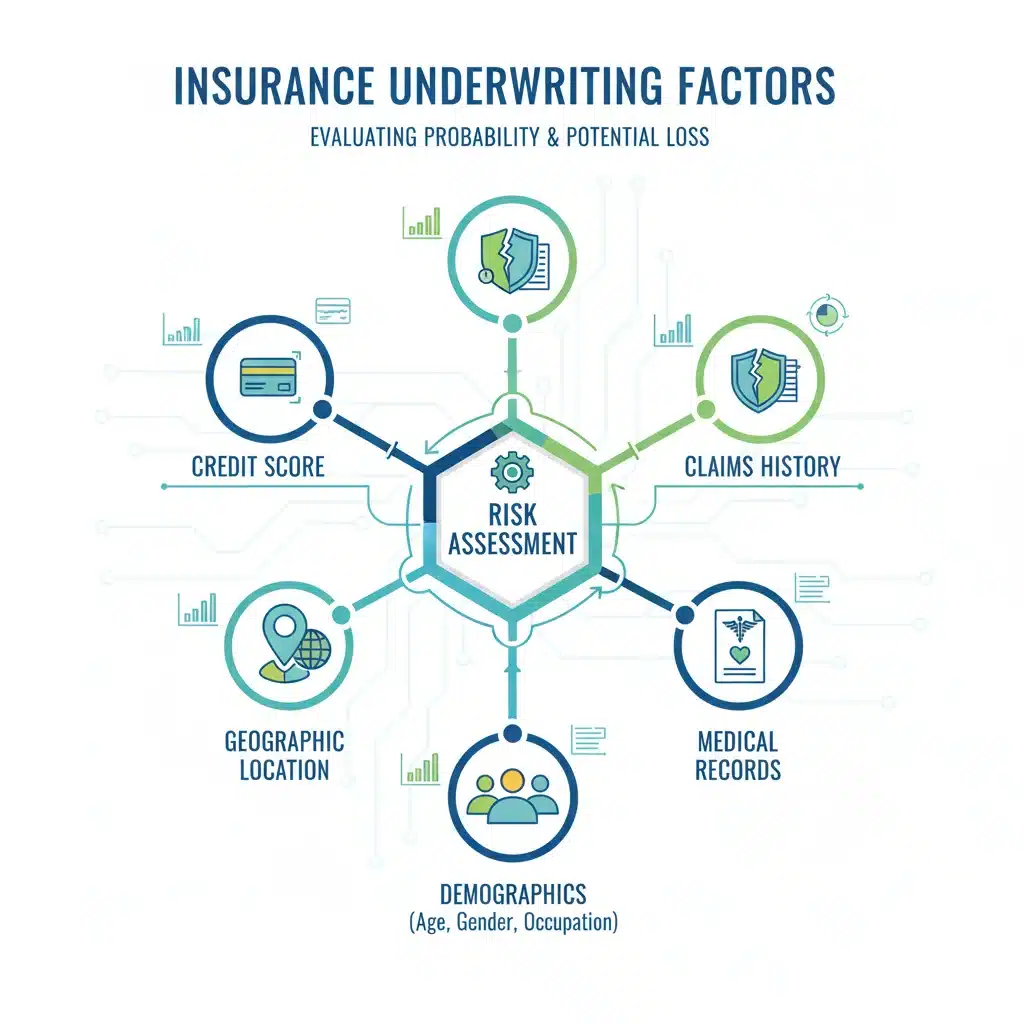
Once the initial information is collected, the underwriter delves into a comprehensive analysis. This is where the core of insurance risk assessment takes place. Underwriters use a variety of tools and resources to evaluate the risk, which may include:
- Actuarial Tables: Statistical data showing probabilities of certain events (e.g., mortality rates, accident frequencies).
- Credit Scores: In some lines of business, credit scores can be predictive of future claims behavior.
- Medical Records: For life and health insurance, detailed medical histories are paramount.
- Property Inspections and Surveys: For property and casualty insurance, physical inspections assess the condition and potential hazards of a property.
- Geographic Data: Location-specific risks such as natural disaster exposure (floods, earthquakes, hurricanes) are critical.
- Claims History: Past claims provide insights into an applicant’s risk profile.
- Industry-Specific Data: For commercial insurance, data related to the specific industry, business operations, and regulatory environment is crucial.
- Public Records: Driving records, criminal records, and other public data can inform risk assessment.
3. Risk Classification and Pricing
Based on the evaluation, the underwriter classifies the risk into a specific category. These categories often range from ‘preferred’ (lowest risk) to ‘standard’ to ‘substandard’ (higher risk). Each risk class has an associated premium rate. The goal is to charge a premium that accurately reflects the probability and potential cost of a claim. This ensures fairness to the policyholder and financial solvency for the insurer.
4. Decision Making: Accept, Decline, or Modify
Finally, the underwriter makes a decision. They can:
- Accept the risk: Offer coverage at the standard or preferred rate.
- Accept with modifications: Offer coverage but with certain exclusions, limitations, or a higher premium (e.g., a rider for a pre-existing condition, or requiring safety improvements for a property).
- Decline the risk: Refuse to offer coverage if the risk is deemed too high or unmanageable.
Challenges in Modern Insurance Risk Assessment
The landscape of risk is constantly shifting, presenting numerous challenges for modern insurance risk assessment:
Emerging Risks
New risks are continually emerging, from cyber threats and data breaches to climate change impacts and global pandemics. Underwriters must develop new methodologies and data sources to accurately assess these novel and often unprecedented risks. Traditional actuarial models may not be sufficient for predicting losses from events that have little to no historical precedent.
Data Overload and Privacy Concerns
While data is a powerful tool, the sheer volume of available information can be overwhelming. Underwriters need sophisticated analytics to extract meaningful insights. Furthermore, the use of personal data raises significant privacy concerns and regulatory challenges (e.g., GDPR, CCPA), requiring insurers to be transparent and ethical in their data practices.
Technological Disruption
The rapid pace of technological change impacts both the nature of risks and the tools available for assessment. Autonomous vehicles, IoT devices, and smart homes introduce new risk profiles that underwriters must understand and price. Simultaneously, these technologies also offer new opportunities for data collection and risk mitigation.
Regulatory Complexity
Insurance is a heavily regulated industry. Underwriters must navigate a complex web of local, national, and international regulations that dictate what data can be used, how premiums can be set, and what disclosures are required. Compliance is a constant challenge and a critical component of ethical underwriting.
Innovations and the Future of Insurance Risk Assessment
The insurance industry is embracing innovation to meet the challenges of modern risk assessment. Several key trends are shaping the future of underwriting:
Big Data and Advanced Analytics
Insurers are leveraging big data and advanced analytical techniques to gain deeper insights into risk. This includes predictive modeling, machine learning, and artificial intelligence. These tools can process vast amounts of structured and unstructured data, identify subtle patterns, and forecast future claims with greater accuracy than traditional methods. For example, telematics in auto insurance uses driving data to personalize premiums, while health insurers use wearable device data to encourage healthier lifestyles and assess risk dynamically.
Artificial Intelligence and Machine Learning
AI and machine learning are revolutionizing underwriting by automating routine tasks, enhancing decision-making, and uncovering previously hidden correlations. AI-powered systems can analyze medical images, process natural language from claims reports, and even assist in fraud detection. This allows human underwriters to focus on more complex cases and strategic decisions.

Internet of Things (IoT) and Telematics
The proliferation of IoT devices, from smart home sensors to connected vehicles, provides insurers with real-time data on risk exposures. Telematics in auto insurance, for instance, allows premiums to be based on actual driving behavior rather than just demographics. Smart home devices can alert insurers to potential issues like water leaks or fire hazards, enabling proactive risk mitigation and potentially lower premiums for policyholders.
Parametric Insurance
Parametric insurance policies pay out based on the occurrence of a specific, measurable event (e.g., an earthquake of a certain magnitude, a specific wind speed) rather than on the actual loss incurred. This approach simplifies claims processing and reduces the need for extensive loss adjustment, offering faster payouts. Underwriting for parametric insurance focuses on the probability and intensity of the trigger event.
Behavioral Economics and Gamification
Insurers are increasingly incorporating insights from behavioral economics to design policies and incentivize risk-reducing behaviors. Gamification, for example, can be used to encourage healthier habits in health insurance or safer driving in auto insurance, leading to a win-win for both policyholders and insurers.
Cyber Underwriting
With the escalating threat of cyberattacks, cyber insurance has become a critical line of business. Cyber underwriting is a highly specialized field, requiring expertise in cybersecurity, IT infrastructure, and data privacy laws. Underwriters assess a company’s cyber defenses, incident response plans, and potential financial impact of a breach to determine coverage and premiums.
The Role of the Underwriter in the Digital Age
While technology is transforming underwriting, the human element remains indispensable. The modern underwriter is no longer just a data processor but a sophisticated risk analyst, strategist, and communicator. Their role involves:
- Interpreting Complex Data: Understanding the output of AI and analytics tools and applying human judgment.
- Developing New Risk Models: Collaborating with data scientists and actuaries to create innovative models for emerging risks.
- Client Relationship Management: Communicating complex underwriting decisions to brokers and policyholders.
- Strategic Decision Making: Making high-stakes decisions that impact the insurer’s profitability and market position.
- Ethical Considerations: Navigating the ethical implications of using advanced data and AI in risk assessment.
Impact on Policyholders: Fairer Premiums and Personalized Coverage
The advancements in insurance risk assessment ultimately benefit policyholders. With more precise risk evaluation, insurers can offer:
- Fairer Premiums: Premiums are more accurately aligned with individual risk profiles, meaning lower-risk individuals are not subsidizing higher-risk ones as much.
- Personalized Coverage: Policies can be tailored more specifically to individual needs and behaviors, offering greater flexibility and relevance.
- Proactive Risk Management: Insurers can provide policyholders with insights and tools to mitigate risks proactively, potentially preventing losses.
- Faster Claims Processing: Better data and analytics can streamline the claims process, leading to quicker payouts when losses occur.
Conclusion: The Dynamic Future of Insurance Underwriting
The role of underwriting in insurance is more dynamic and critical than ever before. As the world continues to evolve, bringing new risks and technological advancements, the process of insurance risk assessment will continue to adapt. From its humble beginnings in London coffee houses to the sophisticated AI-driven analytics of today, underwriting remains the bedrock of the insurance industry, ensuring its stability and its ability to provide essential protection. For both insurers and policyholders, understanding and embracing these changes is key to navigating the complex landscape of risk in the 21st century.
The ongoing integration of big data, AI, and IoT devices promises an even more precise, efficient, and personalized future for insurance. However, this progress must be balanced with robust ethical frameworks and regulatory oversight to ensure fairness, privacy, and accessibility for all. The human expertise of underwriters, combined with cutting-edge technology, will continue to shape how we understand, manage, and mitigate risk, ensuring that insurance remains a vital force for security and progress.